
Learn Tarot: Seven of Swords Meaning
Learn Tarot with That Oracle Guy Patrick. Together we’ll dive into the meanings, symbolism, and history behind each card — with affirmations, journaling prompts, and theme songs to help ground the lessons into your daily life. The Wisdom of Tarot is yours to claim.
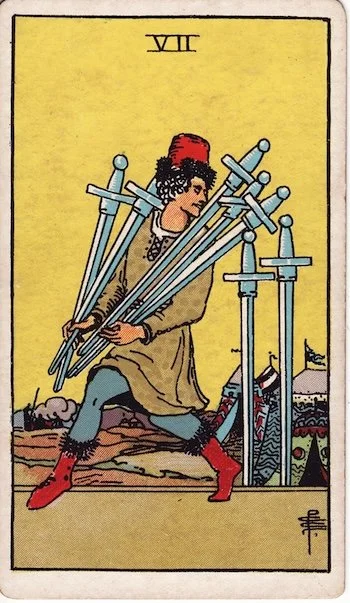
7 of Swords, Rider-Waite-Smith Tarot Deck
Introducing the Seven of Swords:
The Seven of Swords represents a moment where strategy becomes necessary, but integrity becomes questionable. It enters when direct confrontation feels risky, when vulnerability feels unsafe, or when someone believes they must outmaneuver rather than engage honestly. This card is not simply about deception — it is about the psychology behind it.
The Seven of Swords exposes avoidance patterns. Where are you trying to get away with something rather than address it directly. Where are you withholding truth to maintain control. Sometimes this energy shows up as cleverness and tactical thinking. Other times it reveals fear, manipulation, or self-deception. The card challenges you to examine whether your strategy is aligned with your values.
This is a card about mental agility under pressure. But it is also a mirror. If you are navigating quietly, ask yourself why.
Keywords for Seven of Swords:
Strategy
Secrecy
Avoidance
Deception
Cleverness
Independence
Mistrust
Self-interest
Associations:
The Element: Air — intellect, communication, perception, strategy
Numerology: Seven — testing, refinement, challenge, spiritual growth
Card Symbolism:
Man Carrying Five Swords — stealth, self-interest, strategic withdrawal, calculated action
Two Swords Left Behind — unfinished business, loose ends, partial success, consequences
Looking Back Over Shoulder — paranoia, awareness of risk, guilt, fear of being caught
Encampment in Background — community structure, authority, collective rules, social contract
Tiptoeing Posture — secrecy, caution, avoidance, quiet maneuvering
Yellow Sky — mental activity, overthinking, heightened awareness, intellectual tension
Upright Meaning:
Upright, the Seven of Swords suggests a situation where direct honesty feels complicated. You or someone around you may be operating strategically, withholding information, or attempting to secure an advantage quietly.
In some cases, this is intelligent navigation, choosing discretion over drama. In others, it reflects avoidance, manipulation, or a fear of open conflict. The deeper question is whether your actions are aligned with integrity.
Strategy is not inherently unethical, but secrecy rooted in fear creates fragmentation. This card asks you to examine your motives and to consider what long-term stability requires.
Reversed Meaning:
Reversed, the Seven of Swords often indicates exposure. Secrets surface. Hidden motives become visible.
You may be recognizing where you have been avoiding truth or where someone else has not been transparent.
It can also represent a desire to come clean, to correct a misstep, or to stop carrying the mental burden of concealment. In some cases, it warns against internal self-deception, where you are convincing yourself that avoidance is wisdom. The reversal calls for accountability. What has been hidden must be reconciled.
Journal Prompts for Seven of Swords:
Where am I avoiding direct communication out of fear
What strategy in my life feels misaligned with my values
If I were completely honest, what would I need to address
Affirmation:
I choose integrity over avoidance.
My strategy aligns with my values.
I communicate with clarity and courage.
Theme Song:
“Smooth Criminal” — Michael Jackson (1987)
About The Author
Patrick is a professional tarot reader, author, and educator offering online tarot readings and structured tarot education rooted in clarity, depth, and personal growth. His work approaches tarot as a language — one that can be studied, practiced, and refined over time.
Through private readings, the Tarot Circle membership, and Tarot Academy, Patrick helps students and clients develop a grounded, thoughtful relationship with the cards — one that strengthens intuition, critical thinking, and self-trust.
Based in Brooklyn, he works with clients and students around the world.
Ready to experience a deeper tarot journey? Book a reading today or explore more articles and resources at: ThatOracleGuy.com
Book A Tarot Reading:
Recorded 15-Minute Tarot & Oracle Card Reading
Live 15-Minute Tarot & Oracle Card Reading
Recorded 30-Minute Tarot & Oracle Card Reading
Live 30-Minute Tarot & Oracle Card Reading
Recorded 60-Minute Tarot & Oracle Card Reading
Live 60-Minute Tarot & Oracle Card Reading
Enter The Tarot Circle:
The Tarot Circle is a private monthly membership for ongoing spiritual reflection and clarity.
Each month includes three separate recorded releases aligned with the lunar cycle — at the beginning of the month, the New Moon, and the Full Moon. Every release contains over 90 minutes of content, including three complete tarot readings, astrological insights, and guided rituals you can practice at home.
This is not a single monthly tarot reading. It is structured guidance that follows you through the month.
Membership is intentionally limited to 20 people to keep the space focused and personal.
Learn more about the Tarot Circle here.
Tarot Academy: Learn to Read for Yourself & Others
Tarot Academy is an online tarot course designed to teach tarot as a language — slowly, thoughtfully, and with practice.
Rather than memorizing keywords, students learn how to interpret the cards through structure, pattern recognition, symbolism, and lived experience. The curriculum is designed for beginners and developing readers who want a deeper understanding of tarot reading, card meanings, spreads, and interpretation.
Tarot Academy is for those who feel drawn to the cards and want to build real skill, confidence, and clarity in their practice.
Frequently Asked Questions
-
Tarot reading is the practice of interpreting symbols and archetypes to better understand life situations, emotional patterns, and decision points. It is less about prediction and more about intuitive clarity and perspective.
-
Learning tarot involves studying card symbolism, practicing with spreads, and gradually developing the ability to recognize patterns in real-life experiences. With structured guidance, tarot can be learned slowly and thoughtfully over time.
-
Tarot does not create fixed outcomes. It reflects current energies, patterns, and likely directions. The purpose is awareness — which allows for more conscious choice.
-
Tarot follows a structured 78-card system with archetypal patterns. Oracle cards are more flexible in structure and theme. Both can be used for reflection, but tarot has a consistent symbolic framework.
For more detailed answers, visit the full FAQ page here.
