Six of Pentacles Tarot Card Meaning
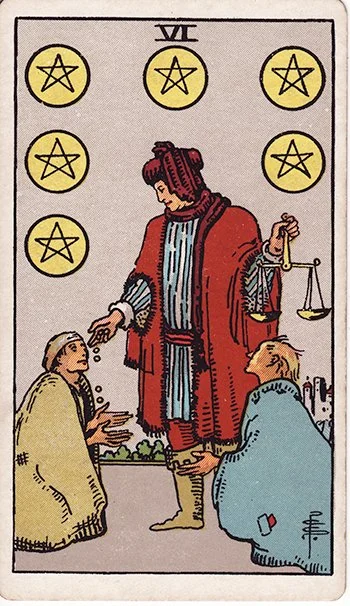
6 of Pentacles, Rider-Waite-Smith Tarot Deck
Learn Tarot with That Oracle Guy Patrick. Together we'll dive into the meanings, symbolism, and history behind each card, with affirmations, journaling prompts, and theme songs to help ground the lessons into your daily life. The wisdom of tarot is yours to claim — and if you're ready to go deeper, Tarot Academy was built for you.
Meeting the Six of Pentacles
After the Five, the Fool had known what it was to be without.
He had stood in the cold with ragged clothes and an empty hand, watching the warm light of other windows, wondering what it meant that some people walked freely while others knelt in the street. He had felt the weight of not-enough — in his pockets, in his body, in some part of himself that he hadn’t been able to name.
And then: movement. The ground had shifted. Something had arrived.
Now the Fool stood in a different scene — or rather, he found himself in two of them simultaneously, which was the peculiarity of the Six of Pentacles. Because this card did not offer one perspective. It offered three. And which one you occupied told you everything about what the card was asking.
The wealthy merchant stood at the center, scales in one hand, pentacles falling from the other. He had what was needed. He was distributing it. There was something in his posture: upright, deliberate, that spoke to genuine intention. He wanted to help. Or believed he did.
The two kneeling figures reached upward, palms open. They needed what the merchant had. They were willing to receive it in the posture of need. There was nothing wrong with that — and yet the posture had a cost, even if they couldn’t see it clearly from where they knelt.
The scales hung between all three of them, measuring something. Not just the distribution of coins. The quality of the exchange. Whether what moved between them was truly mutual — or whether the giving, however generous, still required someone to be smaller.
The Fool looked at the scene and felt the questions shift in him as he moved his gaze.
When he looked at the merchant: Am I giving from genuine overflow, or from the pleasure of being needed?
When he looked at the kneeling figures: Can I receive support without it diminishing how I see myself?
When he looked at the scales: Is there dignity on both sides of this exchange?
The Six of Pentacles was not a simple card. It was a card about the ethics of abundance, and the way that money, support, and generosity are never fully separable from power.
Keywords for the Six of Pentacles
Generosity
Reciprocity
Power dynamics
Giving and receiving
Energetic exchange
Conditional support
Financial assistance
Charity
Circulation of abundance
The dignity of need
Associations
The Element: Earth (material reality, resources, the physical world — here actively in motion rather than accumulated or hoarded)
Numerology: 6 (harmony, balance, integration after conflict — the number of the heart, of giving and receiving, of what becomes possible after the Five’s instability has passed)
Planet: Moon in Taurus (the emotional security of Taurus meeting the fluctuating, responsive quality of the Moon — abundance that flows and ebbs, generosity that is rooted in genuine care)
Zodiac: Taurus
Card Symbolism
The Wealthy Merchant: Draped in fine clothes, standing upright at the center of the card. He represents access — the person who has what is needed, who has the power to give or withhold. His posture is deliberate rather than spontaneous: this is structured generosity, not impulsive largesse. The quality of his giving — its intention, its conditions, its freedom or entanglement — is the card’s central question.
The Scales: Held in the merchant’s left hand, the scales are one of the most significant symbols in the card. They connect the Six of Pentacles to Justice — to the idea that what is given and received should be weighed, measured, and as fair as it can be made. But the scales also point to the complexity: who holds the scales determines how the measurement goes. The merchant holds them, not the recipients. This is part of what the card is asking you to examine.
The Two Kneeling Figures: They receive from a position of physical deference. The posture is significant — not because need is shameful, but because the architecture of the scene places them below the merchant both literally and symbolically. The card asks what this positioning costs them, and what it says about the quality of the exchange. True generosity, the card suggests, does not require the recipient to be smaller for the gift to be given.
The Pentacles Being Distributed: The coins fall from the merchant’s hand to the kneeling figures. Some reach them, some are still in motion. The distribution is active — this is not stored wealth, not accumulated reserves, but wealth in the act of moving. The Six of Pentacles always concerns itself with circulation, not accumulation.
The Red Cloak: The merchant’s red outer garment speaks to passion and vitality — the life force of material engagement. He is not reluctant. He is engaged. Whether that engagement is clean and free or subtly entangled with the pleasure of having power is the question the card leaves deliberately open.
The Blue Inner Robe: Beneath the red: blue, the color of emotion, depth, and the inner life. The merchant has an inner life too — desires, wounds, needs — that are not visible from the kneeling position. The Six of Pentacles asks you to remember that the giver is also a whole person, not merely a vehicle for resources.
Upright Meaning
The Six of Pentacles upright speaks of a moment when the energy of material exchange is flowing — when what was unavailable or blocked is now moving, when the instability of the Five has given way to a more dynamic equilibrium.
At its heart, this card asks a question about the quality of that movement.
Are you the giver or the receiver right now? Both positions have their own wisdom and their own complexity. The card does not romanticize either. The giver may be operating from genuine overflow — giving because they have enough and because circulation is the nature of genuine abundance. Or they may be giving from ego, from the pleasure of being needed, from the subtle satisfaction of occupying the position of power in the exchange.
The receiver may be accepting support with dignity and genuine gratitude, understanding that receiving is as important as giving in any truly healthy exchange. Or they may be accepting support while harboring shame about their need, building resentment about the posture the giving requires, accumulating a private ledger of obligation that is already shaping the relationship.
The upright Six of Pentacles asks: is this exchange clean? Is generosity here given freely, without invisible strings? Is receiving here possible without diminishment? Is the giving empowering the receiver toward their own independence — or subtly maintaining a structure where the merchant remains necessary?
The card can also point to a specific arrival — material support, financial assistance, a mentor who invests in your growth — and mark it as significant. Something is circulating that was not circulating before. The Fool who stood in the cold of the Five now has access to what was unavailable. This matters. Receive it fully, and with dignity.
Spiritually, the Six of Pentacles marks a stage of maturity in the relationship to abundance: understanding that sometimes you are the giver, sometimes you are the receiver, and that neither role permanently defines your worth or your power. Both are part of the circulation. Both are needed.
Six of Pentacles Reversed
Reversed, the Six of Pentacles reveals where the exchange has become entangled with control, ego, shame, or imbalance.
The giver:
Generosity that is performing itself: giving in order to feel powerful, needed, superior, or virtuous
Support offered with invisible conditions: help that is never quite free, that creates obligation, that maintains a subtle power differential
The rescuer pattern: giving continuously to people who remain dependent, because the giving serves a need in the giver that has nothing to do with the recipient’s actual growth
The receiver:
Refusing help because accepting would challenge pride, admit need, or require gratitude that feels like defeat
Accepting help while secretly accumulating resentment about the posture it requires
Shame about need, expressed as either rejection of support or a compulsive seeking of it
The exchange itself:
Financial control disguised as generosity
Relationships structured around indebtedness
The distribution that looks fair from the outside but has conditions embedded in it that only become visible later
The reversed Six of Pentacles is not punishment. It is recalibration — an invitation to examine where the exchange is less clean than it appears, and to ask what it would mean to make it genuinely mutual.
Six of Pentacles in Love & Relationships
If you are in a relationship: The Six of Pentacles in love points directly to the question of balance and reciprocity. Is what is being exchanged between you genuinely mutual — energy, care, emotional labor, financial resources, attention? Or is one person consistently in the position of the merchant while the other is consistently in the position of the kneeling figure?
The card asks whether the imbalance, if present, is a temporary state — one person going through a difficult time and the other carrying more of the weight, with the understanding that this will eventually equalize — or whether it is a structural feature of the relationship, one that serves a need in both people that neither is examining honestly.
If you are single: The Six of Pentacles in a love reading for someone single can point to patterns in how you give and receive in relationships. Do you consistently occupy the giver’s position, more comfortable with generosity than with need? Do you consistently occupy the receiver’s position, finding it easier to be supported than to offer support? The card asks which side of the exchange feels safer — and what it would mean to be equally comfortable in both.
If you have experienced heartbreak: After loss, the Six of Pentacles can appear to mark the arrival of genuine support — from friends, from community, from circumstances that conspire toward your recovery. The card asks you to receive that support with dignity rather than resistance. You were not meant to carry the aftermath alone.
Six of Pentacles in Career & Finances
Career: The Six of Pentacles in a career reading can point to a mentor relationship, a sponsorship, a professional opportunity that comes through someone who has access and chooses to use it on your behalf. It asks you to receive the support fully and to examine the terms honestly — generosity in professional contexts is rarely without structure, and understanding the structure protects both parties.
It can also point to the question of how you exercise whatever professional resources or authority you have. Do you invest in the growth of the people around you? Do you use access to lift others — or to maintain your own central position? The merchant holds the scales. The question is how you hold yours.
Finances: The Six of Pentacles is one of the clearest financial cards in the deck — directly addressing the movement of money between people. It can mark a moment when financial support arrives: a loan, a gift, an investment, an inheritance, assistance from someone who has more and is willing to share.
It can also ask about the terms of that movement. Is money being given freely or with strings attached? Are debts between people creating power dynamics that are warping the relationship? Is financial generosity in your life functioning as a form of control?
The card’s core financial wisdom: abundance is not meant to accumulate in one place. It is meant to move. Give from genuine overflow. Receive with dignity. Keep the exchange clean.
Six of Pentacles & Shadow Work
Am I giving from overflow — or from the need to be needed? The shadow of the giver in the Six of Pentacles is the giving that is actually a form of taking — giving in order to feel powerful, indispensable, superior, or safe. The shadow asks you to trace the root of your generosity honestly. When giving feels compulsive rather than free, when you can’t stop even when you’re depleted, when you feel resentful that your giving isn’t sufficiently acknowledged — these are signs that something other than overflow is operating.
Can I receive without shame? The shadow of the receiver is the wound around need itself — the belief, usually formed early, that needing help is evidence of failure, weakness, or unworthiness. The shadow asks where you learned that self-sufficiency was a virtue and dependence was a vice — and whether that belief is still serving you, or whether it is simply keeping support at arm’s length when you genuinely need it.
What conditions are embedded in the giving I receive? Not all support is clean. The shadow work in examining the Six of Pentacles is in asking honestly whether the help you have accepted in your life came with invisible strings — obligation, indebtedness, the requirement that you remain in a dependent position to keep the support flowing. This is not an exercise in paranoia. It is an exercise in clear seeing.
Do I use my resources to empower or to maintain dependency? For those who occupy the giver’s position with some frequency — in family systems, in friendships, in professional relationships — the shadow asks whether your generosity is structured in ways that help people become more self-sufficient, or in ways that require them to keep coming back. True generosity has an end in mind: the eventual equality of the people on both sides of the scales.
Six of Pentacles in a Tarot Spread
Past position: A past exchange — of money, of care, of support — has shaped the current dynamic. Someone gave and someone received, and the terms of that giving are still present in the relationship or situation you are navigating.
Present position: An exchange is active right now. The card asks you to examine it honestly: which side of the scales are you on? Are the terms of the exchange clean? Is dignity present on both sides?
Future position: A significant exchange of resources, support, or care is ahead. The card asks you to think now about what kind of giver and receiver you want to be — so that when the moment comes, you can engage with it from genuine clarity rather than reactive habit.
Obstacle or challenge position: The obstacle is imbalance in the exchange — either giving that has become controlling, or receiving that has become shame-laden. The challenge is making the exchange genuinely mutual.
Outcome position: The outcome involves resources moving — financial, emotional, or material — in a way that serves genuine growth rather than maintained dependency. The circulation the card describes is available. The question is whether the exchange is clean enough to let it flow.
Common Misconceptions About the Six of Pentacles
“This card is only about money.” The Six of Pentacles addresses the movement of all resources — money, yes, but also time, energy, care, attention, support, knowledge. Wherever one person has access to something another person needs, the dynamics of the Six of Pentacles apply.
“The giver is always the more powerful person.” Power in the Six of Pentacles is complex and contextual. The giver holds the scales — but the giver also depends on the recipient to receive, to validate the gift, to remain in a position of need that makes the giving possible. The card asks both parties to look honestly at how power is operating in their specific exchange.
“Reversed always means someone is being exploited.” The reversed Six of Pentacles can point to exploitation, but it more often points to internal imbalance — shame around receiving, ego entangled with giving, conditions embedded in support that neither party has examined. Look inward before looking outward.
Cards That Relate to the Six of Pentacles
Justice — Justice and the Six of Pentacles both involve the scales — the attempt to measure and distribute fairly. Where Justice operates in the realm of truth and consequence, the Six of Pentacles operates in the realm of material exchange. Together they ask: is what moves between people as fair as it can be made?
Five of Pentacles — The Five of Pentacles is the instability and scarcity that precedes the Six’s circulation. Together they describe the arc from deprivation to recovery — the cold that gives way to the warmth of support, the question of what it means to receive help after having been without.
Four of Pentacles — The Four of Pentacles is what happens when the Six’s circulation stops — when abundance accumulates and hoards rather than moves. Together they describe the full spectrum of material relationship: from generous circulation to fearful accumulation.
The Hierophant — The Hierophant shares the Six of Pentacles’ interest in structured exchange — the giving and receiving of wisdom, tradition, and institutional support. Together they speak to the way that all meaningful exchange has terms, structure, and the question of whether those terms serve genuine growth.
Ten of Pentacles — The Ten of Pentacles is the fully realized abundance that the Six of Pentacles’ circulation eventually produces — the multigenerational wealth, legacy, and material security that becomes possible when resources flow generously over time. Together they describe the long view of what genuine generosity builds.
Journal Prompts for the Six of Pentacles
Think about the most significant exchanges of support in your life — the times someone gave you something substantial when you needed it. What were the terms? Did the giving come with conditions, spoken or unspoken?
Are you more comfortable giving or receiving? What does the less comfortable role feel like in your body? Where do you think that discomfort was formed?
Think about a time you gave generously. Were you giving from genuine overflow — or from something else? What was the “something else”?
Is there a relationship in your life where the exchange is structurally imbalanced — where one person is consistently the merchant and the other is consistently kneeling? What would it mean to make it more mutual?
What would it mean to receive help with full dignity — without shame, without the quiet accumulation of resentment, without the need to immediately repay it in order to feel okay?
The card’s core teaching is that abundance circulates rather than accumulates. Where in your life is abundance stuck — either hoarded or blocked from moving? What would it take to let it flow?
Affirmations
“I give from genuine overflow. My generosity does not require the gratitude of others to be valid.”
“I receive support with dignity. My need does not diminish my worth.”
“Abundance circulates. I am both a generous giver and a graceful receiver.”
“I keep the exchange clean. No invisible strings. No power plays disguised as gifts.”
“True generosity empowers. I give in ways that move people toward their own strength.”
Theme Song:
Count on Me by Bruno Mars, 2011
About The Author
Patrick is a professional tarot reader, author, and educator offering online tarot readings and structured tarot education. His work approaches tarot as a mirror for self-reflection, and as lived experience. The wisdom of tarot is the wisdom of our lives.
Patrick helps students and clients develop a grounded, thoughtful relationship with the cards; one that strengthens intuition and self-trust.
Based in Brooklyn, he works with clients and students around the world, and considers this work his purpose.
Tarot Academy
Want to learn to read this card, and every other card in the deck, with confidence? Tarot Academy is my complete digital course for those ready to go all the way with tarot — covering all 78 cards, their symbolism, their patterns, and how to read them intuitively for yourself and others.
120+ videos. 20+ hours of instruction. One lifetime investment.
Learn More About Tarot Academy →
Book a Tarot Reading
Ready for a personal reading with Patrick? Recorded and live options available.
The Tarot Circle:
A private monthly membership for ongoing guidance, reflection, and ritual. Limited to 20 members, maximum.
Frequently Asked Questions
Can I learn to read tarot myself? Absolutely. It's a skill like anything else: it just takes study, practice, and determination. Tarot Academy was built exactly for this.
Is tarot right for me? Tarot reading is the practice of interpreting symbols and archetypes to better understand life situations, emotional patterns, and decision points. It is less about prediction and more about intuitive clarity and perspective.
Is tarot about predicting the future? Not at all. Tarot highlights current energies, influences, and themes unfolding now — and helps you navigate them consciously. Your future is always shaped by your choices.
Do I need to be spiritual to get a tarot reading? No. All you need is an open mind and good intention. I'll handle the rest.