Seven of Wands Tarot Card Meaning
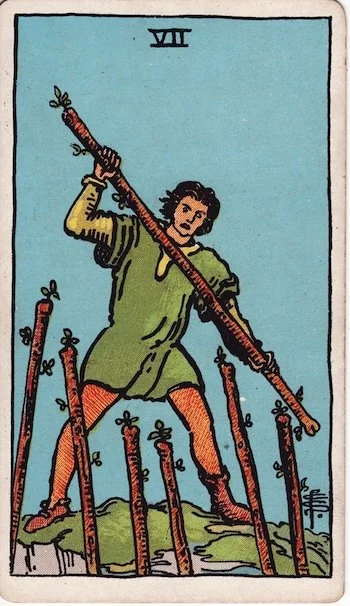
The Seven of Wands is the tarot's card of holding your ground: the defense of a position that was earned and is now being challenged.
Upright, it signals the particular kind of resistance that arrives after success. You've differentiated yourself. You've achieved something visible. Now it's being tested. The card confirms: the ground is worth defending. Stand.
Reversed, the defense has become burnout, defensiveness rooted in fear, or capitulation at the moment conviction was most needed.
This guide covers the full meaning of the Seven of Wands including love, career, shadow work, journal prompts, and affirmations.
Meeting the Seven of Wands
He stood on elevated ground. A small ridge, a hilltop, the kind of high position that feels like advantage until it becomes a target.
Below him, six wands rose upward from hands he couldn't quite see. Not in greeting. In challenge.
He looked down at the wand in his own hands. He noticed, absurdly, that he was wearing mismatched shoes. He hadn't prepared for this. He'd thought the celebration was the end of the struggle.
He’d thought wrong.
“What do they want?”
A voice, maybe the wind, maybe something in him, answered: “What you have.”
He steadied himself on the ridge. The six wands below weren't all malicious. Some were competitive. Some were simply testing. Some were questioning whether he deserved the position he held. Some might even have a point.
And there it was. The real challenge had nothing to do with the people below. It had everything to do with whether he believed, in the cold light of opposition, that he deserved to stand where he stood.
He raised his wand. Not in aggression. In declaration.
“I earned this,” he said. Quietly.
More to himself than to anyone below.
He didn't charge. He didn't retreat. He held his ground on the ridge, wand raised, mismatched shoes and all. Imperfect, unprepared, and entirely unwilling to be moved.
Victory isn't the end of the test. It's the beginning of a different one.
Keywords for Seven of Wands
Conviction
Defense
Standing your ground
Perseverance under pressure
Courage of position
Challenge after success
Identity under stress
Holding the high road
Associations
The Element: Fire (passion, drive, the will to assert and sustain — tested now rather than ignited)
Numerology: 7 (the number of challenge, inner examination, and the refinement of what has been built — the point where everything is tested before it can deepen)
Season: The suit of Wands governs summer and the south — the Seven arrives at high heat, when the fire has been burning long enough to meet real resistance
Astrology: Mars in Leo (the warrior energy of Mars expressed through Leo’s pride, identity, and creative self-expression — the will to defend what you have made and who you are)
Card Symbolism
The Central Figure on High Ground: He stands above the opposition — elevated, not by accident but by effort. The high ground in the Seven of Wands is earned ground. He is defending a position he has climbed to, not one he was given. The elevation is both his advantage and the reason he is being challenged.
The Six Wands Rising from Below: Six wands rise up from unseen hands — opposition, competition, challenge, critique. They are not all the same. Some represent genuine competitors. Some represent the skepticism of others. Some represent the inner voice that questions whether the position was legitimately earned. The card does not tell you which is which. It asks you to hold your ground regardless.
The Wand in His Hand: He has one wand. They have six. The numbers are not in his favor — but the high ground is. The card’s teaching is that position, preparation, and conviction can hold against greater numbers. One person who truly believes in what they are defending is harder to move than six people testing for weakness.
The Mismatched Shoes: One of the most overlooked details in the entire suit — he is wearing two different shoes. He was not prepared for this. He did not expect the challenge to come so soon after the victory. The mismatched shoes are not a flaw in the card’s design — they are its most human detail. You will rarely be fully prepared when the test arrives. You hold your ground anyway.
The Leaning Forward Posture: He leans into the challenge rather than away from it. This posture is not aggression — it is engagement. The Seven of Wands does not advise retreat, but it also does not advise reckless charge. It advises the particular posture of someone who has decided not to be moved: present, committed, steady.
The Open Blue Sky: Above the figure, the sky is clear and open. Whatever the opposition below represents, it is not the end of the world. The clarity of the sky above reminds us that the challenge, however intense it feels, is bounded. The horizon beyond it is still open.
The Green Tunic: The figure wears green — the color of growth, vitality, and forward motion. Even in defense, the Seven of Wands is a Fire card. The life force is still present. The ambition is still alive. What is being defended is not just ground already taken but the continued possibility of what comes next.
Upright Meaning
The Seven of Wands arrives at a specific moment in every Wands journey: the moment after you have established something real, when the world begins to push back.
The Five of Wands was the chaos of competition before the victory. The Six of Wands was the recognition — earned, public, genuine. The Seven is what comes next: the discovery that success creates visibility, and visibility invites challenge. The people below did not appear before the Six. They appeared because of it.
This card is not about random opposition. It is about the particular kind of resistance that arises when you have differentiated yourself — when you have claimed a position, expressed a point of view, achieved something that others notice. When you step forward, some people will be inspired. Others will test you. The Seven of Wands is addressed to the moment when the testing begins.
What distinguishes the Seven of Wands from defensiveness is the quality of the conviction behind it. The card draws a clear line between defense born from integrity and defense born from fear or ego. The person on the high ground in this card is not reacting — they are holding. There is a steadiness to the posture that comes from genuine belief in the position being defended. The question the card asks is whether your conviction is that deep.
When the Seven of Wands appears upright, it is confirming that you have earned your ground — and asking whether you know it. The challenge ahead is real. But so is what you have built. Stand.
Seven of Wands Reversed
The Seven of Wands reversed speaks to what happens when the pressure of sustained defense becomes something other than strength.
The most common expression is burnout from constant challenge — the exhaustion of someone who has been on the ridge too long, wand raised, and has begun to wonder whether the ground is worth defending anymore. This is not weakness. It is a legitimate question that the reversed card takes seriously. Sometimes the answer is yes — rest, recalibrate, return. Sometimes the answer reveals that what you have been defending was pride rather than purpose.
The second expression is defensiveness rooted in fear — not holding your ground from conviction but reacting to every perceived threat with immediate resistance. The wand is raised before the challenge has been clearly seen. This posture exhausts without protecting. The reversed Seven asks: are you responding to what is actually happening, or to what you are afraid might happen?
The third expression is its opposite: capitulation — backing down too quickly from a position that deserves to be held, abandoning your voice to avoid conflict, shrinking when the moment asks you to stand. This often masquerades as flexibility or humility, but the card is honest about what it actually is: the failure of conviction at the moment it was most needed.
The reversed Seven of Wands asks one clarifying question: are you defending your truth, or your pride? The answer changes everything.
Want to explore what this card means for your specific situation?
Book a private reading with Patrick →Seven of Wands in Love & Relationships
If you are in a relationship: The Seven of Wands in a love reading often signals a need to establish or defend a boundary — to hold a position within a relationship that has been tested, questioned, or pushed against. It can appear when one person’s needs, values, or sense of self is being challenged by the dynamic of the partnership, and the card asks: can you hold your ground here without becoming defensive or aggressive? The distinction is important. Standing in your truth within a relationship is not the same as fighting to win.
It can also signal external pressure on a relationship — criticism from family, interference from others, or the general noise of people who have opinions about what you are building together. The card confirms that what you have built is worth defending. Stand together.
If you are single: The Seven of Wands in a love reading for someone single often points to the defense of hard-won standards — the resistance to lowering the bar simply because loneliness makes the pressure to do so feel urgent. The card asks: can you hold the ground of your own values in the dating landscape, which often rewards those who compromise themselves most readily?
If you have experienced heartbreak: The Seven of Wands can appear after loss as a call to defend the self — to protect the inner ground of your own identity, sense of worth, and belief in what you deserve from a relationship. The challenge may be coming from grief itself, from the inner voice that uses loss as evidence of unworthiness. Stand on the ridge. You earned that ground before the loss, and it is still yours.
Seven of Wands in Career & Finances
Career: The Seven of Wands in a career reading is one of the clearest signals the deck offers of the particular challenge that follows success: competition for the position you’ve earned, skepticism about your credentials, or the simple pressure of being visible enough to attract opposition.
This card appears when your ideas are being challenged in a meeting, when a promotion you’ve worked for is being contested, when your creative or professional direction is being questioned by people with less investment in it than you have. It confirms that the opposition is real — and that you have what it takes to meet it. The key is not matching the aggression of the challenge but outlasting it through the steadiness of your conviction.
It can also signal a moment of creative courage: the choice to defend an unconventional approach, an original idea, or a direction that others don’t immediately understand. The Seven of Wands says: hold the high ground. You got there by knowing something others don’t yet see.
Finances: In a financial reading, the Seven of Wands often signals a need to defend a financial position or decision under pressure — from others’ skepticism, from market volatility, from the inner voice that second-guesses every choice when things get hard. The card asks whether the financial direction you have committed to is grounded in genuine conviction or in hope alone. If it is genuine, hold it. If it is hope, the honest examination the reversed card calls for is worth doing.
Seven of Wands & Shadow Work
The shadow of the Seven of Wands lives in the space between genuine conviction and the performance of it — and in all the ways we confuse defending our truth with defending our ego.
What am I actually defending? The most clarifying shadow question this card offers. Every defense has an object — something being protected. For some people it is genuinely their values, their creative vision, their hard-won ground. For others, on honest examination, it is the story they tell about themselves, the identity they have built around a particular success or position, the pride that cannot admit challenge without feeling annihilated. The shadow work is in being honest about which is true.
Where does my conviction come from? Genuine conviction is quiet in a particular way — it doesn’t need the opposition to stop in order to feel real. It exists independent of whether others validate it. The shadow of the Seven of Wands is the conviction that collapses the moment no one is cheering, the position that requires constant external confirmation to feel worth holding. The shadow asks: does your belief in what you have built exist when no one is watching? Can you hold the ridge even in silence?
Where am I so defended that nothing can reach me? The shadow of this card can harden into rigidity — the person who has been challenged so many times that every question feels like an attack, every piece of feedback feels like an assault on the ground itself. The wand that was a tool of defense becomes a wall. The high ground that was earned becomes a prison. The shadow asks: have you stopped being able to receive anything from below because you have been defending against it for so long?
What would it cost me to step down from the ridge? Sometimes the shadow of the Seven of Wands is the inability to stop defending. The battle that was genuinely necessary at one point has continued past its usefulness, and the person on the ridge has forgotten that they are allowed to come down. The shadow asks: is there a position you are still defending that has already been won — or that no longer needs to be held?
Tarot Academy
The Only Tarot Course You’ll Ever Need
Most tarot courses end at the cards: Tarot Academy takes you all the way. From learning all 78 cards in full depth, to developing your intuition, to launching a professional tarot practice.
Seven of Wands in a Tarot Spread
Past position: A period of sustained defense or challenge in the past required you to stand your ground under pressure. The conviction you demonstrated then — or the ground you gave up — has shaped the current situation. What happened when you were last tested this way?
Present position: You are currently on the ridge. Something you have built, claimed, or achieved is being challenged, questioned, or tested. The card asks you to assess your position honestly: is what you are defending worth defending? And if yes — hold. Don’t charge, don’t retreat. Hold.
Future position: A challenge is coming — the particular kind that arrives after success, after visibility, after you have established something real. The card is not a warning. It is a preparation. The ground you are building now will be worth defending then. Know what you stand for before the test arrives.
Obstacle or challenge position: The obstacle is either the opposition itself (genuine external challenge requiring genuine conviction) or your own relationship to challenge (defensiveness, exhaustion, or the failure of conviction at the critical moment). Identify which before deciding how to respond.
Outcome position: The situation resolves through the quality of your conviction — not through the elimination of the opposition but through your willingness to hold your ground long enough for the challenge to reveal whether it has real substance or was testing you to see if you’d move.
Common Misconceptions About the Seven of Wands
“This card means I should fight everyone who disagrees with me.” The Seven of Wands asks for selective, grounded defense — not reactive combat with every voice of opposition. The figure on the ridge is not charging down the hill. He is holding position. The card asks you to know which battles are genuinely yours, which challenges deserve engagement, and which simply need to be outlasted.
“The six wands below mean I’m outnumbered and should give up.” The numbers are not the point. The high ground is the point. The Seven of Wands does not promise that the challenge will be small or fair — it promises that the position is defensible if the conviction behind it is real. One person who genuinely believes in what they are holding can outlast six people who are testing rather than committed.
“Reversed means I’ve lost.” The Seven of Wands reversed is not defeat — it is a call for honest examination. It asks whether the defense is still necessary, whether the conviction is still genuine, or whether exhaustion has made a previously valid position untenable. The question it poses is clarifying, not final.
Cards That Relate to the Seven of Wands
Six of Wands — The Six is the recognition that precedes the Seven’s challenge. You cannot fully understand the Seven without the Six: the high ground was earned in the victory, and the opposition below appeared because the victory was visible. Together they trace the arc from earned success to the defense of it — the complete picture of what it means to achieve something real in the world.
Five of Wands — The Five is the chaotic competition that preceded the Six’s victory — the scramble before the breakthrough. The Seven returns to challenge, but with a crucial difference: in the Five, no one has yet established a position. In the Seven, you have. The challenge is no longer about competing from equal ground but about defending elevated ground. Together these two cards define the full spectrum of the suit’s conflict energy.
Nine of Wands — The Nine of Wands is where the Seven of Wands leads when the defense has been sustained for too long without resolution — the weariness of the battle-worn figure who has been on guard so long that the vigilance has become exhausting. Together they trace the arc of sustained challenge: the Seven holds; the Nine endures; the question of what comes after endurance is the bridge between them.
The Emperor — The Emperor and the Seven of Wands both deal with the defense of position and the authority of earned ground. The Emperor holds his throne through structure, discipline, and the force of established order. The Seven holds the ridge through conviction, presence, and the refusal to be moved. Together they speak to the full range of what it means to defend what you have built — from the structural to the personal.
Strength — Both Strength and the Seven of Wands require the person to hold a position under pressure without resorting to force. Strength does it through inner presence and compassionate engagement with what is wild. The Seven does it through conviction and the refusal to be driven off earned ground. Together they define two of the tarot’s most important teachings on what genuine power looks like when it is tested.
Journal Prompts for the Seven of Wands
What position are you currently defending, and do you genuinely believe it deserves to be held? Take the ego out of the answer as much as you can. What is actually worth standing for here?
Think about a time when you backed down from a position you should have held. What made you move? What did it cost you? What would you do differently?
Think about a time when you held your ground under genuine pressure. What gave you the conviction to stay? What does that moment tell you about what you actually believe in?
Where in your life right now are you defending your truth — and where are you defending your pride? Be honest about the difference. They require very different things from you.
The figure in the card is wearing mismatched shoes — unprepared, imperfect, in the middle of a challenge he didn’t fully anticipate. When have you had to hold your ground without being ready? What did that experience reveal about your actual convictions?
What ground have you earned in your life — creative, professional, personal — that you sometimes forget is legitimately yours? What would it look like to stand on it with less apology?
Affirmations
“I earned this ground. I know what I stand for. I will not be moved.”
“My conviction does not require the opposition to stop in order to be real.”
“I hold my position with steadiness, not aggression — with presence, not performance.”
“I choose my battles from integrity, not fear. I hold the ones that matter.”
“Imperfect and unprepared, I stand anyway. That is what courage actually looks like.”
Theme Song:
Eye of the Tiger by Survivor, 1982
About The Author
Patrick is a professional tarot reader, author, and educator offering online tarot readings and structured tarot education. His work approaches tarot as a mirror for self-reflection and lived experience. The wisdom of tarot is the wisdom of our lives.
Patrick helps students and clients develop a grounded, thoughtful relationship with the cards. One that strengthens intuition and self-trust. Based in Brooklyn, he works with clients and students around the world.
Tarot Academy
Want to learn to read this card, and every other card in the deck, with confidence? Tarot Academy is my complete digital course for those ready to go all the way with tarot. Covering all 78 cards, their symbolism, their patterns, and how to read them intuitively for yourself and others.
120+ videos. 25+ hours of instruction. One lifetime investment.
Learn More About Tarot Academy →
Book a Tarot Reading
Ready for a personal reading with Patrick? Recorded and live options available.