Nine of Swords Tarot Card Meaning
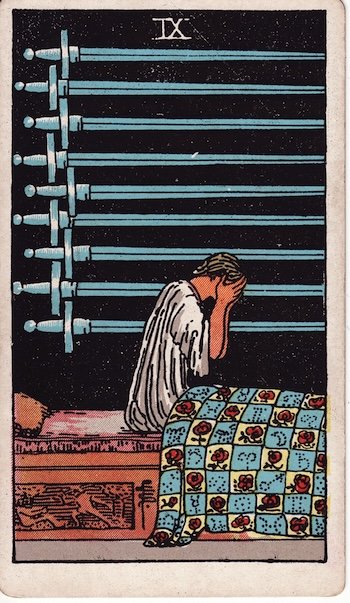
The Nine of Swords is the tarot's anxiety card: the mind that has turned against itself, the 3am thoughts that feel like certainties, the suffering that is real even though its source is internal.
Upright, it signals acute mental anguish: rumination, sleeplessness, fear that has grown beyond its proportionate relationship to what is actually happening in the room.
Reversed, the worst of the mental anguish is shifting, though not always toward relief. The suffering may be lifting, or it may have gone underground.
This guide covers the full meaning of the Nine of Swords including love, career, shadow work, journal prompts, and affirmations.
Meeting the Nine of Swords
He woke up at 3am and didn't know why.
He sat up in the dark, heart already moving fast, reaching for the thing that had woken him. There was nothing there. No sound, no danger, no reason. Just the dark and the silence and the mind already running.
It started small. A worry about something said wrong. A decision made months ago that suddenly felt catastrophic. A fear about the future with no particular evidence behind it, only the absolute certainty, available only at this hour, that everything was going to go wrong.
The nine swords hung on the wall behind him. He hadn't put them there. But they had been waiting.
He had faced real battles. Real losses. Genuine trials. And somehow, none of it had undone him the way this did: this quiet room, this dark hour, this mind with nothing to fight but itself.
He sat in the dark and understood something the daylight had always hidden: that the mind, left alone with enough silence and enough fear, is capable of constructing suffering more vivid than anything the world had actually delivered.
The question wasn't what was wrong. The question was whether he could remember, in the dark, that the swords weren't real.Keywords for Nine of Swords
Anxiety
Rumination
Sleeplessness
The 3am mind
Fear and dread
Mental anguish
Catastrophizing
The suffering we create
Associations
The Element: Air (the mind, thought, mental patterns — here, the mind consuming itself)
Numerology: 9 (near-completion, intensity, the accumulated weight of everything the suit has carried — in Swords, this is the point of maximum mental suffering)
Planet: Mars in Gemini (the aggressive, driven energy of Mars expressed through the quick, restless, dual-natured mind of Gemini — thought turned combative, the mind that can't stop)
Zodiac: Gemini
Card Symbolism
The Figure Sitting Up in Bed They have woken — or perhaps never slept. The posture is unmistakable: hunched forward, head buried in hands, the body language of someone overwhelmed not by an external threat but by what is happening inside their own mind. They are alone. The room is dark. No one is coming.
The Nine Swords on the Wall Nine blades, horizontal, mounted on the wall behind the figure. They are not threatening the person directly — they are simply there, hanging in the dark, present and unavoidable. This is the card's most important visual truth: the swords are not in the room attacking. They are in the mind. The suffering is real, but its source is internal.
The Darkness The room is black. There is no window, no light source, no visible world beyond the bed. The Nine of Swords lives in the absence of perspective — in the particular quality of night that makes fears feel larger and certainties feel impossible. Darkness is not just atmosphere here. It is the condition that makes this card's suffering possible.
The Quilt The bedcover beneath the figure is decorated with roses and astrological symbols — beauty and order, hidden beneath the anguish. The quilt suggests that the life this person is living is not, in fact, a disaster. The symbols of meaning and beauty are literally woven into the fabric beneath them. But they cannot see it right now.
The Carved Bed Panel The side of the bed shows a carved scene — one figure apparently defeating another. Some read it as defeat, some as justice. Either way, it suggests that the stories we tell ourselves while lying in the dark are already shaped by older narratives of loss and struggle.
The Absence of Other People The figure is entirely alone. One of the core features of this card's suffering is its isolation — not because no one cares, but because anxiety, at its most acute, convinces us that we are the only ones who have ever felt this way, and that no one else could possibly understand.
Upright Meaning
The Nine of Swords upright is the card of the mind that has turned against itself.
This is the anxiety card, the insomnia card, the 3am card. It appears when mental suffering has reached an acute point — when worry has become rumination, when fear has become dread, when the thoughts won't stop regardless of what you do to quiet them.
What makes this card distinct from other difficult Swords cards is the source of the suffering. The Eight of Swords showed a figure imprisoned by external circumstances and her own perception of them. The Nine of Swords shows a figure whose prison is purely internal. The room is empty. The swords are on the wall, not in hand. No one is attacking. The suffering is being generated entirely from within.
This doesn't make it less real. Anxiety is not imaginary. The pain of the Nine of Swords is genuine — it is simply not proportionate to anything actually happening in the room right now. And that gap between the intensity of the suffering and the reality of the threat is both the card's challenge and its opening.
In evolutionary tarot, this card often arrives as an invitation to examine the relationship between your thoughts and your reality. Not to dismiss the fear, but to ask: is what I'm believing right now actually true? Or is this the 3am version of the story — the version that only makes sense in the dark?
When you pull the Nine of Swords upright, ask: What am I believing right now that I would not believe in the morning?
Nine of Swords Reversed
The Nine of Swords reversed means the worst of the mental anguish is shifting — but the direction of that shift matters.
Nine of Swords reversed key meanings:
Beginning to emerge from a period of acute anxiety or depression
Seeking help — therapy, support, honest conversation — after suffering alone
Releasing a fear or shame that has been held in secret
In some readings: the suffering has been internalized so deeply it's become invisible — numbing rather than healing
The inner critic quieting, or getting louder in a different register
The reversed Nine doesn't always mean relief. Sometimes it means the anxiety has gone underground — still present, but no longer acknowledged. The most honest question this reversal asks is: has the suffering actually lessened, or have you simply gotten better at hiding it, even from yourself?
Want to explore what this card means for your specific situation?
Book a private reading with Patrick →Nine of Swords in Love & Relationships
If you are in a relationship: The Nine of Swords in a love reading often speaks to anxiety about the relationship itself — fears that are running far ahead of any actual evidence. Worrying about what a silence means, what a shift in tone portends, whether the distance you're feeling is the beginning of something worse.
This card can also appear when past wounds are being activated by present circumstances — when something about the current relationship is touching an older hurt, and the mind is responding to that older story as much as to what's actually happening now.
The invitation is always the same: say the fear out loud. The thought that is most catastrophic in the dark almost always loses some of its power when spoken into the room.
If you are single: The Nine of Swords can indicate anxiety about love itself — about whether connection is possible, whether you are lovable, whether the patterns of the past are permanent. These fears feel most true at 3am. They are not the full truth.
If you have experienced heartbreak: This card can appear in the acute phase of grief — when the mind cycles obsessively through what happened, what was said, what could have been different. The suffering is real. The obsessive quality of the thinking is the card's signature, and it is the thing that, gently, needs to be interrupted.
Nine of Swords in Career & Finances
Career: The Nine of Swords in a career reading often reflects work-related anxiety that has grown beyond its actual proportions — catastrophizing about a mistake, dreading a conversation, convinced that a professional failure is imminent or already decided. The mind has gotten ahead of the evidence.
It can also indicate burnout presenting as anxiety: the accumulated stress of too much pressure over too long a period, finally surfacing as sleeplessness, dread, and the inability to turn off the professional mind even in hours that are supposed to be rest.
Finances: Financially, the Nine of Swords often speaks to money anxiety — the 3am worry about whether there will be enough, whether a decision was catastrophically wrong, whether the financial ground beneath you is as solid as it needs to be. Sometimes this fear is pointing to something real that needs attention. More often it is pointing to the need for honest information, because anxiety fills the space that clarity would occupy.
Nine of Swords & Shadow Work
The shadow of the Nine of Swords is the relationship we have with our own suffering — and specifically, with the part of us that believes the worst-case story.
Do I believe my 3am thoughts? This is the shadow's first question. The mind at its most anxious is extraordinarily convincing. It presents fears as facts, worst-case scenarios as certainties, old wounds as current realities. The shadow work is in developing the capacity to notice: this is the anxiety talking — and to understand that the anxiety, however loudly it speaks, does not have access to the whole truth.
What am I using the worry to avoid? Rumination is sometimes a way of staying in motion while standing still — the mind keeps cycling not because it is solving the problem but because stopping the cycle would mean sitting with something even harder. Fear about the future can be a way of not fully inhabiting the present. The Nine of Swords shadow asks: what would I have to feel if the worry stopped?
Who taught me that vigilance was safety? For many people, anxiety was originally adaptive — a nervous system that learned, in response to real instability or threat, that constant monitoring was necessary for survival. The shadow work is in recognizing that what protected you once may now be the source of its own kind of suffering. The hypervigilant mind is not broken. It is doing exactly what it learned to do. The question is whether you still need it to.
Am I ashamed of the suffering? One of the cruelest features of this card's energy is the shame that often accompanies it — the belief that the anxiety is a weakness, a failure, something to be hidden. The figure in the image is alone in the dark. The shadow work is in asking: who would I let in, if I believed the suffering was something I deserved support for?
Tarot Academy
The Only Tarot Course You’ll Ever Need
Most tarot courses end at the cards: Tarot Academy takes you all the way. From learning all 78 cards in full depth, to developing your intuition, to launching a professional tarot practice.
Nine of Swords in a Tarot Spread
Past position: A period of acute mental anguish, anxiety, or sleeplessness has shaped the situation you're in now. Something was carried in the dark for longer than it needed to be. That experience is part of what brought you here.
Present position: You are in the middle of the spiral right now. The thoughts feel most true at this hour. The invitation is not to fight them directly — it is to ask whether what you are believing is actually proportionate to what is real.
Future position: A period of heightened anxiety or mental stress is ahead. The preparation is not to avoid it but to build the inner resources — honesty, support, perspective — that will allow you to move through it without being consumed by it.
Obstacle or challenge position: The obstacle is the mind itself — the story it is telling, the fears it is amplifying, the suffering it is generating in the absence of actual threat. The question is not what is wrong in the outer world. The question is what the inner world is doing with the silence.
Outcome position: The situation resolves once the mental pattern breaks — either through honest confrontation with the fear, through seeking support, or through the simple, humbling act of waiting for morning. Things will look different in the light.
Common Misconceptions About the Nine of Swords
“This card means something terrible is about to happen.” The Nine of Swords is not a predictive card — it does not announce disaster. It reflects an internal state. The suffering it depicts is real, but its source is the mind, not the future. What is about to happen is not necessarily terrible. What is happening right now is a mind in pain.
“If I pull this card, I must be mentally ill.” The Nine of Swords reflects the experience of anxiety and rumination — which are universal human experiences, not diagnoses. Everyone has 3am thoughts. This card appears when that experience is particularly acute or consuming. It is not a clinical label. It is an honest mirror.
“Reversed means the anxiety is over.” The reversed Nine of Swords does not guarantee resolution. It can indicate relief — or it can indicate that the suffering has gone underground, become habitual, or been suppressed rather than genuinely addressed. The direction of the reversal requires context and honesty to read accurately.
Cards That Relate to the Nine of Swords
Eight of Swords — The Eight of Swords precedes the Nine in the suit's arc. The Eight shows a figure bound and blindfolded but still standing, still outside — the imprisonment is real but not yet internalized. The Nine is what happens when the fear comes home and wakes you up at 3am. Together they trace the progression from external constraint to internal anguish.
The Moon — The Moon and the Nine of Swords share the same territory: the night, the fear, the world of distorted perceptions and half-truths. The Moon asks you to walk through the dark with your eyes open. The Nine of Swords shows what it looks like when the dark walks through you.
Ten of Swords — The Ten of Swords follows the Nine — the culmination, the collapse, the point where the suffering finally reaches its end. Paradoxically, the Ten often brings more relief than the Nine: at least it's over. The Nine is the suffering that hasn't resolved yet.
The Star — The Star is the Nine of Swords' antidote. Where the Nine is darkness and dread, The Star is the quiet, steady light that remains after the worst has passed. These two cards in a reading together often speak to a person moving — slowly, imperfectly — from one state toward the other.
Four of Swords — The Four of Swords is the rest the Nine of Swords is desperately trying to find. Where the Nine is the mind that won't stop, the Four is the deliberate, sacred practice of stopping. Pulling both cards is a clear signal: the exhaustion is real, and the only way through is to genuinely rest.
What To Do When You Pull the Nine of Swords
Name the thought, then question it. Write down the specific fear — not the vague dread, but the actual sentence your mind keeps returning to. Then ask: is this true? What's the evidence? What would I say to a friend who told me they were thinking this? The anxiety loses some of its power when it has to answer questions.
Notice the hour. If the worst thoughts come at night, that is information. The Nine of Swords is specifically a card of distorted night-time perception. This does not mean the fear is meaningless — but it does mean that what feels certain at 3am deserves to be tested in the morning before being acted on.
Tell someone. The figure in the image is alone, in the dark, with the door closed. The suffering of this card is intensified by isolation. Whatever you are carrying — say it to someone you trust. Not to be fixed, necessarily. Just to not be alone with it.
Ask what the anxiety is trying to protect. Anxiety is not random noise. It is a signal, however distorted. Underneath the catastrophizing is usually a real need, a real fear, a real wound. The Nine of Swords invites you to look past the surface spiral and ask what it's actually about.
Journal Prompts for the Nine of Swords
What thought do you keep returning to — the one that feels most true in the dark? Write it down, then write the counter-evidence.
When did you first learn to worry? What were you protecting yourself from, and does that threat still exist in the same way?
What would you need to believe — about yourself, about life, about the future — for the anxiety to genuinely ease?
Is there a fear you have been carrying alone that deserves to be spoken out loud? What has kept you from saying it?
What does your 3am mind believe that your 3pm mind does not? Which one is telling the fuller truth?
If the worry stopped completely, what would you have to face in the quiet?
Affirmations
"My thoughts are not facts. I have the capacity to question what I believe."
"I am safe in this moment. What is happening right now is survivable."
"I do not have to carry this alone. Support is available to me."
"The fear feels largest in the dark. I trust the morning to offer perspective."
"I am not my anxiety. I am the awareness that notices it."
Theme Song
One Step Closer by Linkin Park, 2000
About The Author
Patrick is a professional tarot reader, author, and educator offering online tarot readings and structured tarot education. His work approaches tarot as a mirror for self-reflection and lived experience. The wisdom of tarot is the wisdom of our lives.
Patrick helps students and clients develop a grounded, thoughtful relationship with the cards. One that strengthens intuition and self-trust. Based in Brooklyn, he works with clients and students around the world.
Tarot Academy
Want to learn to read this card, and every other card in the deck, with confidence? Tarot Academy is my complete digital course for those ready to go all the way with tarot. Covering all 78 cards, their symbolism, their patterns, and how to read them intuitively for yourself and others.
120+ videos. 25+ hours of instruction. One lifetime investment.
Learn More About Tarot Academy →
Book a Tarot Reading
Ready for a personal reading with Patrick? Recorded and live options available.