Ten of Swords Tarot Card Meaning
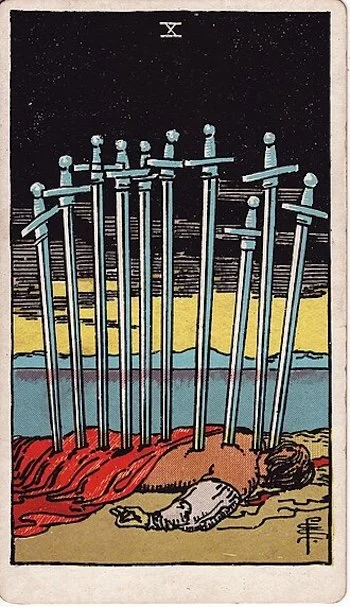
The Ten of Swords is the tarot's card of rock bottom: the painful ending that is complete, final, and paradoxically clarifying.
Upright, a figure lies face down with ten swords in their back. The sky above is dark. The water ahead is calm. On the horizon, unmistakably, the sun is beginning to rise. The worst has already happened. The bracing is over. The morning is arriving anyway.
Reversed, the ending is being resisted, or the slow process of rising has begun.
This guide covers the full meaning of the Ten of Swords including love, career, shadow work, journal prompts, and affirmations.
Meeting the Ten of Swords
He was face down on the ground.
Ten swords in his back. The sky above him dark, the water still and quiet ahead. He could not move. He was not trying to move. The fall was over and he knew it. Completely, finally, undeniably over.
Something had ended. Not slowly, not ambiguously. It had ended the way only some things end: all the way, with nothing left to soften.
He lay there in the dark and waited for what would come next.
He hadn't expected it. On the horizon, unmistakably, the sun was beginning to rise. A band of gold broke across the edge of the world, reflected in the calm water ahead. Not yet full light. But coming.
The worst had already happened.
And the morning was arriving anyway.
He understood something then that he could only have understood from this position, from the bottom of it, with nothing left to brace against: the suffering of the Nine had been the dread of this moment. But the moment itself was different. Quieter. The bracing was over. The thing had happened.
Rock bottom has a strange quality to it. When there is nothing left to lose, the fear finally stops.
Keywords for Ten of Swords
Endings
Rock bottom
Betrayal
Painful completion
The moment after the worst
Release through finality
Dawn after darkness
The end of a cycle
Associations
The Element: Air (the mind, thought, communication — here, the full culmination of the Swords suit’s relationship with pain, conflict, and mental suffering)
Numerology: 10 (completion, the end of the cycle — in Swords, this completion is the most dramatic in the deck: total, final, and paradoxically liberating)
Planet: Sun in Gemini (the clarity and illumination of the Sun expressed through the dual, communicative nature of Gemini — the dawn that follows the darkest night, the truth that finally surfaces)
Zodiac: Gemini
Card Symbolism
The Figure Face Down: Prostrate, motionless, ten swords in the back. There is no ambiguity in this image — this is the end, and it is complete. The figure is not struggling. The fall is over. This is one of the most confronting images in the tarot, and it is meant to be: the Ten of Swords does not soften its message. Something is finished.
The Ten Swords: Ten blades, all of them present, none of them held back. This excess is significant — one sword would have been enough. Ten is overkill, and that quality of excess speaks to something true about this card’s experience: it is not a small ending. It is a total one. The accumulation of the Swords suit has reached its absolute limit.
The Dark Sky: Dramatically black above the figure — the visual representation of the darkest moment. The sky is at its most ominous directly overhead, the point of greatest despair. And yet it is only the sky directly above that is this dark. The card contains both the night and the morning simultaneously.
The Golden Dawn: On the horizon, unmistakably, the sun is rising. A band of gold and warmth breaks across the edge of the world, reflected in the still water ahead. This is the detail that transforms the Ten of Swords from a card of pure despair into something more complex: the dawn is already happening. The worst has not prevented the morning. It has, in a strange way, made room for it.
The Calm Water: Still, reflective, peaceful ahead of the figure. Not stormy, not turbulent — calm. The chaos is behind him, not ahead. Whatever lies on the other side of this ending is not more of what produced it. The water says: there is peace available, once you can rise and walk toward it.
The Red Cape: A red cloth covers the lower half of the figure — some read it as a shroud, some as dignity preserved even in the moment of defeat. Either way, it suggests that something essential remains intact. This is not annihilation. It is an ending — and there is a difference.
The Stillness of the Body: The figure is not mid-fall — they have fallen. This is the moment after the crisis, not the crisis itself. The Ten of Swords does not depict the moment of impact. It depicts the moment after, when everything is quiet and the full reality of what has happened can finally be seen.
Upright Meaning
The Ten of Swords upright is the card of rock bottom — and the strange, specific relief that comes with it.
This card marks a painful ending: a betrayal, a collapse, a defeat that is complete and final. Something that has been building through the Swords suit — the avoidance of the Two, the heartbreak of the Three, the exhaustion of the Nine — has arrived at its natural conclusion. It is over. Completely, undeniably over.
What the Ten of Swords offers that no preceding card can is finality. The dread of the Nine, the paralysis of the Two, the grief of the Three — all of them exist in relationship to something that might still happen. The Ten of Swords is the card of the thing that has already happened. And once the worst has arrived, the bracing against it ends.
There is something almost clarifying about rock bottom. When there is nothing left to lose, the fog of fear and anticipation lifts. The situation is exactly what it is, no longer what it might become. From this point, the only direction available is forward — toward the dawn that is already breaking on the horizon.
In evolutionary tarot, this card often invites an important distinction: the Ten of Swords is an ending, not a death. The figure in the image has fallen, but the dawn is there. The water is calm. The card does not say the story is over — it says this chapter is over, completely, and the next one begins now.
When you pull the Ten of Swords upright, ask: What is finally, completely over — and can I let it be over, rather than continuing to suffer what has already ended?
Ten of Swords Reversed
The Ten of Swords reversed suggests the ending is being resisted, delayed, or slowly released.
Ten of Swords reversed key meanings:
Refusing to accept that something is over — holding on past the natural end
Slowly rising from a painful ending, beginning to heal
A crisis that was feared has not materialized — the worst did not come to pass
Recovering from betrayal, defeat, or rock bottom with growing resilience
In some readings: cycles of crisis repeating because the lesson has not yet been integrated
The reversed Ten of Swords asks: are you in the rising, or in the refusing? Both are available from the position of the fallen figure. One moves toward the dawn. The other continues to lie in the dark, insisting the sun should not be coming up yet. This card asks which you are choosing — and whether that choice is conscious.
Want to explore what this card means for your specific situation?
Book a private reading with Patrick →Ten of Swords in Love & Relationships
If you are in a relationship: The Ten of Swords in a love reading marks an ending — a final rupture, a betrayal that has broken something beyond repair, or the complete collapse of a dynamic that has been deteriorating through the suit. This is not a card of rough patches. It is a card of genuine completion.
If the relationship is still technically ongoing, this card asks for radical honesty: is this ending being acknowledged, or is it being denied? Sometimes the Ten of Swords appears before the official end — when something has already died and neither person has yet said so.
If you are single: The Ten of Swords can appear in the aftermath of a relationship that ended badly — betrayal, abrupt loss, the kind of ending that left swords in the back. The grief is real. The injury is real. And the card holds both of those things while also pointing to the dawn: this is over, which means healing can now begin.
If you have experienced heartbreak: This card can arrive as a strange validation — an acknowledgment that what happened was as bad as it felt, that the pain is proportionate to the loss. But it pairs that validation with the horizon: the dawn is there. The worst has happened. The only direction now is toward the light.
Ten of Swords in Career & Finances
Career: The Ten of Swords in a career reading marks a significant professional ending — a job lost, a business collapsed, a professional relationship severed in a way that felt like betrayal. The fall is complete. Something that was built is no longer standing.
This card does not soften the reality of that loss. But it does offer the same thing it offers everywhere: the dawn. The career that has ended was not the only one possible. The professional identity that has collapsed was not the only one available. The water ahead is calm. There is ground beneath the horizon.
It can also appear when a career needs to end — when the situation has become genuinely untenable and continuing is doing more damage than stopping. In this context the Ten of Swords is not a catastrophe arriving. It is a permission finally being given.
Finances: Financially, the Ten of Swords can mark the bottom of a difficult period — debt reached its limit, a financial situation collapsed completely, a loss that could not be avoided has arrived. Rock bottom, financially. And with it, paradoxically, a kind of clarity: this is the situation exactly as it is. From here, rebuilding can begin.
Ten of Swords & Shadow Work
The shadow of the Ten of Swords lives in our relationship to endings — and specifically, in what we do when something is over and we refuse to let it be.
Am I suffering what has already ended? This is the shadow’s central question. One of the most common and least acknowledged forms of human suffering is the continuation of pain past the event that caused it — the wound that has closed being reopened through rumination, the relationship that ended being relitigated endlessly in the mind, the defeat that is complete being treated as still ongoing. The Ten of Swords shadow is the person lying face down long after the dawn has broken, insisting it is still night.
What would I have to become if I let this be over? Endings require us to update our identity. If I am no longer in that relationship, who am I? If that career is gone, what am I? If that belief has collapsed, what do I believe now? Sometimes the suffering is maintained not because the pain is so acute but because the ending, if truly accepted, would require a self that does not yet exist. The shadow work is in building the willingness to become that person.
What is the story I am telling about what happened? The Ten of Swords is also a card of narrative — of the meaning we make from the worst things that happen to us. The shadow asks: is the story I am telling about this ending accurate? Is it fair — to myself and to others? Is it keeping me in the dark, or helping me move toward the light? The story of betrayal can be true and also, at some point, need to be set down.
Where did I learn that I deserved this? Some people carry the Ten of Swords as an identity — as proof of something they always suspected about themselves or the world. That bad things happen to them. That people cannot be trusted. That love ends in swords. The shadow work is in examining whether the ending is evidence for a conclusion, or whether the conclusion was there first and the ending is being recruited to confirm it.
Tarot Academy
The Only Tarot Course You’ll Ever Need
Most tarot courses end at the cards: Tarot Academy takes you all the way. From learning all 78 cards in full depth, to developing your intuition, to launching a professional tarot practice.
Ten of Swords in a Tarot Spread
Past position: A painful ending, a betrayal, or a rock-bottom experience has shaped the person you are now. Something fell apart completely — and the falling was real, and the impact was real. What did you build from the wreckage? What do you now know that you could only have learned from that place?
Present position: You are at or near the bottom of something right now. The invitation is not to rush the rising — but to let the full reality of what has ended actually land, rather than managing it from a distance. The dawn is already breaking. You do not need to manufacture the light. You need to let yourself see it.
Future position: A significant ending is ahead — one that will feel like too much, and then will be over. Begin now to build the relationship to finality that will allow you to rise when it comes. The swords are not permanent. The dawn is.
Obstacle or challenge position: The obstacle is the refusal to let something be over — the continued suffering of what has already ended, the swords kept in place by a grip that has become, somehow, its own comfort. What would it mean to pull them out?
Outcome position: The situation completes — fully, finally, with the quality of absolute ending that only the Ten of Swords carries. This is not a partial resolution. It is the end of this chapter. And the horizon beyond it is already brightening.
Common Misconceptions About the Ten of Swords
“This card predicts death or disaster.” The Ten of Swords is not a literal card. It does not predict physical death or imminent catastrophe. It speaks to the experience of endings — the kind that feel total and final. It is a card of metaphorical rock bottom, not a forecast of literal harm.
“It’s the worst card in the deck.” The Ten of Swords is one of the most visually confronting cards in the tarot, but it is not purely a card of despair. It contains the dawn. It depicts the moment after the worst — which is also the moment when rising becomes possible. Many readers find the Three of Swords, with its ongoing grief, more difficult to sit with than the Ten, which at least is finished.
“Reversed means the situation gets worse.” The reversed Ten of Swords most often indicates the process of recovery — rising slowly from the fallen position, integrating the ending, beginning to heal. It can also indicate resistance to accepting an ending, but it rarely signals that the worst is still ahead.
Cards That Relate to the Ten of Swords
Nine of Swords — The Nine of Swords precedes the Ten: the anticipatory dread, the sleepless anxiety, the suffering of what might happen. The Ten is what the Nine was afraid of — and paradoxically, it is in some ways easier. The Nine is the fear; the Ten is the thing itself. After the Ten, the Nine has nothing left to threaten.
Three of Swords — Both cards deal in heartbreak and painful endings, but the Three of Swords is grief — raw, present, ongoing. The Ten of Swords is finality. The Three is the wound in the hours after impact; the Ten is the wound that has reached its absolute limit. Together they trace the arc of how pain travels through the Swords suit.
Death — Death and the Ten of Swords are the tarot’s two great cards of ending and transformation. Death is the Major Arcana version — the large, unavoidable turning of a cycle. The Ten of Swords is the Minor Arcana version — more personal, more specific, more immediately painful. Both cards say: this is over, and what comes next is different from what came before.
The Star — The Star is the natural companion to the Ten of Swords — the card of renewal that becomes possible after the worst has passed. The Ten is the night; The Star is what shines in it. These two cards in a reading together are one of the tarot’s most honest pairings: the devastation is real, and the healing is also real.
Ace of Swords — The Ace of Swords waits on the other side of the Ten — the new beginning that only becomes possible once the old cycle has fully ended. The Ten clears the ground completely. The Ace plants the first new thing. Together they are the death and rebirth of the mind’s relationship to truth.
What To Do When You Pull the Ten of Swords
Let it be over. This is the card’s primary invitation and its hardest ask. Whatever has ended — let it be ended. Stop relitigating it, stop hoping it will reverse, stop carrying the swords as though removing them would undo what happened. The wound is real. The ending is also real. Both can be true.
Turn toward the dawn. The figure in the image has the dawn ahead of them. It requires only the turn of the head to see it. This is not toxic positivity — the darkness is real and the fall was real. But the light is also real, and it is already there. You do not have to manufacture hope. You only have to be willing to look.
Give yourself time to lie still. Rock bottom does not require immediate rising. There is a necessary period after a major ending — of stillness, of integration, of simply being with what has happened before trying to build what comes next. This card does not demand that you get up immediately. It asks only that you know the dawn is there when you are ready.
Be honest about what ended. Not the story you tell others, or even the story that protects you from the full weight of what happened — but the honest account. What was this? What did it mean? What is actually gone? The clarity that comes from honest reckoning with an ending is the foundation of genuine recovery.
Journal Prompts for the Ten of Swords
What has ended in your life that you have not fully allowed to be over? What would it mean to truly let it go?
Think of a time you hit rock bottom. What did you find there? What did you build from that place that you could not have built from anywhere else?
What is the story you tell about your worst endings — about betrayal, loss, or defeat? Is that story serving you, or keeping you in the dark?
Where in your life are you still bracing against something that has already happened? What would it feel like to unclench?
What does the dawn in your Ten of Swords moment look like — specifically? What is the life that becomes possible once this ending is fully accepted?
Is there something that needs to end right now that you are holding open past its natural completion? What is the cost of that?
Affirmations
“This is over. I release it with honesty and with grief, and I turn toward what comes next.”
“Rock bottom is not the end of my story. It is the end of this chapter.”
“I am allowed to lie still for a while. The dawn will wait for me.”
“What ended was real. What is possible now is also real.”
“I rise. Not immediately, not perfectly — but I rise.”
Theme Song
Fix You by Coldplay, 2005
About The Author
Patrick is a professional tarot reader, author, and educator offering online tarot readings and structured tarot education. His work approaches tarot as a mirror for self-reflection and lived experience. The wisdom of tarot is the wisdom of our lives.
Patrick helps students and clients develop a grounded, thoughtful relationship with the cards. One that strengthens intuition and self-trust. Based in Brooklyn, he works with clients and students around the world.
Tarot Academy
Want to learn to read this card, and every other card in the deck, with confidence? Tarot Academy is my complete digital course for those ready to go all the way with tarot. Covering all 78 cards, their symbolism, their patterns, and how to read them intuitively for yourself and others.
120+ videos. 25+ hours of instruction. One lifetime investment.
Learn More About Tarot Academy →
Book a Tarot Reading
Ready for a personal reading with Patrick? Recorded and live options available.