Eight of Swords Tarot Card Meaning
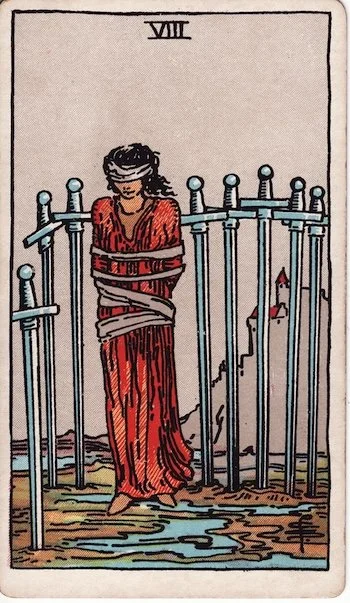
The Eight of Swords is the tarot's card of mental imprisonment: the prison that the mind builds and maintains, often more effectively than any external force could.
Upright, it signals the particular paralysis of a person who believes they have no options when the swords surrounding them don't actually touch her, the blindfold was self-applied, and the path out is closer than it appears.
Reversed, liberation is beginning, or the suffering has gone deeper underground: suppressed rather than resolved.
This guide covers the full meaning of the Eight of Swords including love, career, shadow work, journal prompts, and affirmations.
Meeting the Eight of Swords
She had stopped moving.
She wasn't sure when it happened. Only that at some point, the path had narrowed, and the thoughts had crowded in, and now there were swords everywhere: tall and silent and surrounding her on all sides.
She couldn't see them. A blindfold had been tied around her eyes. She couldn't say by whom.
Her hands were bound. Loosely, she thought. Or maybe she'd stopped trying to test that a long time ago.
The ground beneath her feet was wet. She could feel it. Not solid ground. Mud, something that shifted under the weight of her stillness.
In the distance, though she couldn't see it, a castle rose against the grey sky. A place she had come from, or a place she could go back to. She wasn't sure anymore.
The swords did not touch her. They stood around her like sentinels, or like thoughts. Sharp and present and just close enough to make her afraid to move.
But they were not a cage.
They never had been.
She stood very still, and told herself she had no choice.
Keywords for Eight of Swords
Restriction
Mental imprisonment
Victimhood
Fear
Paralysis
Overthinking
Powerlessness
Blind spots
Associations
The Element: Air (the mind, thought, communication, belief)
Numerology: 8 (cycles, momentum, cause and effect — here, the cycle of self-reinforcing fear)
Planet: Jupiter in Gemini (expansive thinking turned inward, mental energy without direction)
Zodiac: Gemini
Card Symbolism
The Blindfold: Perhaps the most important symbol in the card. She cannot see — but the blindfold was not placed there by some external force. It represents the stories we tell ourselves, the beliefs we've inherited, the fears that distort our perception of what's actually possible.
The Bindings: Her hands are tied, but loosely. The binding is real — but it is not absolute. The suggestion is that the restriction could be loosened, if she tried. If she believed it was worth trying.
The Eight Swords: They surround her but do not touch her. They form a kind of fence — but there are gaps. The prison is psychological, not physical.
The Shallow Water: She stands in water, not on solid ground. Water in tarot represents emotion and the subconscious. She is standing in her own emotional landscape, unable to move forward because the ground itself is uncertain.
The Distant Castle: Behind the swords, a castle rises in the background — civilization, safety, a place she came from or could return to. It is visible to us but not to her. The way back — or the way forward — exists. She simply cannot see it.
Her Posture: Head slightly bowed, turned away. The body language of someone who has given up — or who is waiting for someone else to set her free.
The Grey Sky: The entire scene is muted, overcast. This is the landscape of anxiety, of a mind that has been clouded by fear for so long that it can no longer imagine color.
Upright Meaning
The Eight of Swords upright is the card of the mind that has become its own captor.
It arrives when you feel trapped — by circumstances, by other people, by a situation that seems to have closed in on all sides. But the Eight of Swords carries a specific message: the prison is largely mental. The swords that surround the figure don't touch her. The bindings are loose. The path out exists — but fear, shame, or ingrained belief has made it invisible.
This is one of the most honest cards in the tarot about the nature of psychological suffering. It doesn't minimize the experience of feeling trapped — the fear is real, the paralysis is real, the sense of helplessness is real. But it gently, unflinchingly points to the role the mind plays in maintaining those conditions.
In evolutionary tarot, the Eight of Swords marks a moment of profound spiritual invitation hidden inside profound psychological pain. The question is not who did this to you — though that question may be valid. The question is what beliefs are keeping you here? What stories about yourself, about what's possible, about what you deserve, are functioning as the blindfold?
When you pull the Eight of Swords upright, ask: What am I not allowing myself to see? What would become possible if I stopped believing I had no choice?
Reversed Meaning
Reversed, the Eight of Swords can move in two meaningful directions.
The first is liberation — the blindfold beginning to slip, the bindings loosening, the first courageous step out of the mental prison. This is the more hopeful reversal: an awakening to the fact that the cage was never fully locked, that the swords were not as impenetrable as they seemed, that movement is possible after all. Something has shifted in the inner landscape — a realization, a moment of clarity, a decision to stop waiting.
The second is deeper entrenchment — a refusal to take responsibility for the role the mind has played in creating the experience of restriction. Reversed, this card can sometimes point to someone who has identified so fully with their victimhood that they resist the possibility of freedom, because freedom would require them to relinquish a story they've been holding for a long time.
Either way, the Eight of Swords reversed asks: Am I moving toward clarity — or am I finding new ways to avoid it?
Want to explore what this card means for your specific situation?
Book a private reading with Patrick →Eight of Swords in Love & Relationships
In a love reading, the Eight of Swords often points to a relationship dynamic shaped by fear, restriction, or deeply held limiting beliefs.
If you're in a relationship: This card can indicate feeling trapped or powerless within the relationship — a sense that you have no real options, no voice, no ability to change things. Sometimes this reflects genuine dynamics of control or emotional suppression that need to be addressed directly. Other times, it points to internal patterns — the belief that you don't deserve better, that leaving would be impossible, that speaking up would be catastrophic — that are creating the experience of imprisonment more than the relationship itself is.
The Eight of Swords in a relationship reading is an invitation to examine what you actually believe about your situation — and to distinguish between what is genuinely happening and what fear has constructed.
If you're single: This card may reflect old relational wounds — past experiences of betrayal, rejection, or powerlessness — that have created a set of beliefs making it difficult to open up or trust again. The blindfold isn't protecting you. It's simply preventing you from seeing what's available.
If you've experienced heartbreak: The Eight of Swords can appear when someone is stuck in the aftermath of a painful relationship — replaying it, catastrophizing, unable to imagine a different future. The grief is real. But at some point, the mind begins to construct a prison out of it.
Eight of Swords in Career & Finances
In a career reading, the Eight of Swords often reflects a situation where someone feels professionally stuck — and where the stuckness is at least partly a product of their own thinking.
Career: This card can appear when someone believes they have no options — that they're trapped in a job they hate, that no one would hire them elsewhere, that it's too late to change direction, that they don't have what it takes to pursue what they actually want. The Eight of Swords doesn't dismiss these concerns, but it does ask: how much of this is true, and how much is fear talking?
It can also point to workplace dynamics where someone feels silenced, undervalued, or controlled — and has stopped believing they have any agency in the situation. Again, the card invites an honest examination of what is actually fixed and what has only felt fixed for so long that it seems immovable.
Finances: Financially, this card often reflects a mindset of scarcity and powerlessness — the belief that money will always be tight, that financial freedom isn't available, that there are no real options for improving the situation. The Eight of Swords asks whether those beliefs are accurate — or whether they are the blindfold.
Eight of Swords & Shadow Work
The Eight of Swords is one of the most revealing shadow work cards in the entire deck — because it points directly to the mind's capacity to imprison itself.
In evolutionary tarot, shadow work involves reclaiming the parts of ourselves we've hidden, suppressed, or disowned. But the Eight of Swords points to a particular kind of shadow: the shadow of helplessness. The part of us that has decided — consciously or not — that powerlessness is safer than agency.
Why would powerlessness feel safe? Because if you have no power, you can't make the wrong choice. You can't fail. You can't be blamed. The cage, as constraining as it is, has a kind of protection built into it. The Eight of Swords shadow is the part of us that chose the blindfold — and keeps choosing it.
Key shadow work questions the Eight of Swords invites
What story am I telling myself about why I can't? The Eight of Swords lives in the language of impossibility. Shadow work here means getting specific — not I can't but I'm afraid that if I try, I will... That completion is where the real work begins.
Where did I learn that I was powerless? Most Eight of Swords patterns have roots. A childhood environment where agency was punished. A relationship where having needs was dangerous. A system that repeatedly communicated that people like you don't get to choose. The shadow work isn't to dismiss those origins — it's to examine whether they are still as true as they once were.
What would I have to take responsibility for if I removed the blindfold? This is the hardest question the Eight of Swords asks. Sometimes the blindfold stays on because seeing clearly would require action — and action feels more terrifying than the prison.
Tarot Academy
The Only Tarot Course You’ll Ever Need
Most tarot courses end at the cards: Tarot Academy takes you all the way. From learning all 78 cards in full depth, to developing your intuition, to launching a professional tarot practice.
Eight of Swords in a Tarot Spread
Past position: A period of mental restriction, fear, or powerlessness has shaped the situation you're in now. The beliefs formed during that time — about yourself, about what's possible, about whether you're safe to act — may still be operating beneath the surface.
Present position: You are in the middle of a psychological bind. Something is keeping you stuck — and the work right now is to examine how much of that restriction is external and how much is internal. The swords are present. But they are not touching you.
Future position: A period of mental challenge, self-doubt, or restricted thinking is approaching. This card in the future position is a heads-up: watch for the moment when fear begins to construct the story that you have no options. That story will not be true.
Obstacle or challenge position: The obstacle is internal. Fear, limiting belief, or a deeply held story about powerlessness is the primary thing standing between you and movement. The challenge is not to defeat the external circumstances — it's to examine the mind generating them.
Outcome position: The situation does not resolve easily. There may be a period of genuine difficulty or restriction ahead. But the Eight of Swords as an outcome is rarely permanent — it is a state, not a destiny. The resolution begins the moment the blindfold starts to slip.
Common Misconceptions About the Eight of Swords
"The Eight of Swords means I'm genuinely trapped with no way out." The swords in this card do not form a sealed enclosure. There are gaps. The figure is bound loosely. The card is not saying the situation is hopeless — it is saying that fear has made it appear that way. The way out exists. It requires courage, not magic.
"This card is about external control by other people." While external factors can absolutely contribute to a situation of restriction, the Eight of Swords is primarily a card of the mind. Even when real external pressures exist, this card asks what internal beliefs are amplifying or maintaining the experience of powerlessness.
"The Eight of Swords reversed always means freedom." Not necessarily. As noted above, the reversal can also point to a deeper entrenchment in victimhood — a refusal to see the ways in which agency is available. Context matters, as always.
Cards That Relate to the Eight of Swords
Understanding the Eight of Swords in relationship to other cards deepens your readings significantly.
Seven of Swords → Eight of Swords: The Seven of Swords is the card of avoidance, strategy, and the sneaking away from something difficult. The Eight of Swords is, in part, what happens when that avoidance catches up with you — when the thing you sidestepped returns as a mental prison. The Seven runs; the Eight stands still, unable to run anymore.
Two of Swords: Both cards feature a blindfolded figure. The Two of Swords is the deliberate choice not to look — a stalemate held in place by will. The Eight of Swords is what that choice eventually becomes: a prison. Together in a reading, they suggest a pattern of avoidance that has compounded over time.
The Devil: The Devil is the Major Arcana card most closely related to the Eight of Swords. Both speak to bondage, restriction, and the illusion of being trapped. But where The Devil's chains are rooted in attachment and shadow, the Eight of Swords' prison is constructed from thought and fear. Together, they point to a deep pattern of self-imposed limitation — one that requires both awareness and will to dissolve.
The Moon: The Moon governs fear, illusion, and the distortions of the unconscious mind. Alongside the Eight of Swords, it suggests a situation where anxiety and imagination are working together to construct a reality more frightening than the one that actually exists. The mind is not to be trusted entirely in this reading.
Nine of Swords: In sequence, the Nine of Swords follows the Eight — and escalates it. Where the Eight is paralysis, the Nine is the dark night of the soul, the 3am spiral, the mind fully turned against itself. Together, they trace the arc of unchecked mental suffering. Seeing both in a reading is a strong signal to seek support.
What To Do When You Pull the Eight of Swords
The Eight of Swords doesn't ask you to immediately shatter the prison. It asks you to look at it honestly.
Question the story. When you find yourself saying I have no choice or there's nothing I can do, treat that as a signal — not a fact. Ask: is that actually true? What would I need to believe differently for an option to become visible?
Remove the blindfold one layer at a time. You don't have to see everything at once. Start with one honest question: What am I not letting myself look at? The answer to that question is usually the beginning of the way out.
Notice where the swords actually are. Some of the restrictions you're experiencing are real. Some are projected. The Eight of Swords asks you to do the difficult work of distinguishing between the two — not to dismiss your circumstances, but to reclaim the agency that exists within them.
Seek perspective from outside your own mind. The figure in the card is isolated. One of the most practical responses to this card is to talk to someone — a therapist, a trusted friend, a mentor — who can see the gaps in the sword formation that you currently cannot.
Journal Prompts for the Eight of Swords
What story am I telling myself about why I'm stuck — and how much of it is actually true?
Where in my life am I waiting for someone else to set me free?
What would I do if I genuinely believed I had more options than I currently think I do?
What am I afraid of seeing if I remove the blindfold?
Affirmations
"I am not my fear. I am the awareness behind it."
"I have more agency than I have been allowing myself to believe."
"I choose to see clearly, even when clarity asks something of me."
Theme Song
Breathe (2 AM) by Anna Nalick, 2005
About The Author
Patrick is a professional tarot reader, author, and educator offering online tarot readings and structured tarot education. His work approaches tarot as a mirror for self-reflection and lived experience. The wisdom of tarot is the wisdom of our lives.
Patrick helps students and clients develop a grounded, thoughtful relationship with the cards. One that strengthens intuition and self-trust. Based in Brooklyn, he works with clients and students around the world.
Tarot Academy
Want to learn to read this card, and every other card in the deck, with confidence? Tarot Academy is my complete digital course for those ready to go all the way with tarot. Covering all 78 cards, their symbolism, their patterns, and how to read them intuitively for yourself and others.
120+ videos. 25+ hours of instruction. One lifetime investment.
Learn More About Tarot Academy →
Book a Tarot Reading
Ready for a personal reading with Patrick? Recorded and live options available.