Seven of Swords Tarot Card Meaning
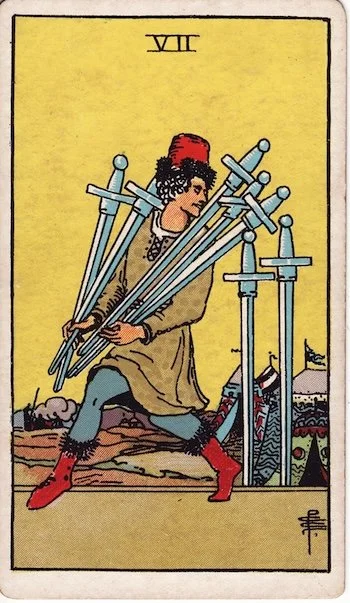
The Seven of Swords is the tarot’s card of strategic evasion: the exit that avoids confrontation, the truth that is never quite told, the thing taken quietly while no one is watching.
Upright, it holds up a mirror. Not always to someone else’s deception. More often to the places where you are maneuvering around something instead of moving through it.
Reversed, the strategy is unraveling, or the pattern is finally being honestly confronted.
This guide covers the full meaning of the Seven of Swords including love, career, shadow work, journal prompts, and affirmations.
Meeting the Seven of Swords
He was already moving when the card appeared.
Five swords in his arms, taken quietly from the encampment while the others weren't watching. His posture was practiced: low, careful, each step placed with precision. He looked back over one shoulder. Not in guilt, exactly, but in the particular awareness of someone who knows they're doing something they'd rather not be caught doing.
Two swords remained behind him, planted in the ground.
He hadn't taken everything. That was interesting.
He moved through the pale morning light, the camp behind him, the open landscape ahead. He was clever. He knew he was clever. He'd navigated a situation that direct confrontation would have made worse. Or so he'd told himself. He'd taken what he needed and left before it became complicated.
But the two swords left behind followed him in a way he hadn't anticipated. Not physically. As a question.
Why those five? Why not all seven? What exactly are you not ready to deal with?
The tents of the encampment grew smaller behind him. He kept moving.
The Seven of Swords is rarely about someone else's deception. More often it's a mirror, asking where you're maneuvering around something instead of moving through it.
Keywords for the Seven of Swords
Strategy
Deception
Avoidance
Calculated retreat
Getting away with something
Mental cunning
Evasion
Acting alone
Half-measures
The incomplete exit
Associations
The Element: Air (the mind, strategy, logic, communication — here applied not to truth-telling but to strategic evasion)
Numerology: 7 (reflection, inner knowing, the pause before deeper truth — here turned inward as self-justification rather than genuine inquiry)
Planet: Moon in Aquarius (detachment and rationalization in service of emotional avoidance — the ability to analyze and plan without fully feeling the consequences)
Zodiac: Aquarius
Card Symbolism
The Figure Carrying Five Swords: The central figure moves quickly and quietly, arms full of swords he is taking without permission or announcement. Five swords — not all of them, but most. The act is calculated: take enough to gain advantage, leave enough to claim you didn’t take everything.
The Two Swords Left Behind: These are the swords the figure couldn’t carry — or chose not to take. They represent what couldn’t be fully resolved, what was left incomplete, the loose ends of the strategic exit. You can’t take everything in a quiet escape. Something always remains.
The Backward Glance: The figure looks back over his shoulder — not forward at his destination, but back at the camp he is leaving. This is the tell. He is watching for consequences, for witnesses, for evidence that his plan is working. The gaze backward is the gaze of someone who knows, on some level, that what they are doing requires monitoring.
The Raised Foot — the Smirk: Some readings of the card see a smirk on the figure’s face, a lightness in his step. The pleasure of having gotten away with something. The self-satisfaction of successful strategy. This is part of what makes the card complex: the strategy is working, and it feels good, and that feeling of cleverness is part of what makes the pattern hard to interrupt.
The Distant Camp: The soldiers in the background are gathered around a fire, apparently unaware. The social world the figure is extracting himself from — the community, the collective, the relationships and obligations he is quietly departing. They may not know yet. They may know more than the figure realizes.
The Yellow Sky: In Waite-Smith imagery, yellow often signals the mental realm — the life of the mind, thought, analysis. The sky here is yellow, grounding the action in the intellectual: this is a mental strategy, a calculated move, the mind in service of avoidance.
Upright Meaning
The Seven of Swords upright is the card of strategy in service of evasion — the exit that avoids confrontation, the truth that is never quite told, the thing taken quietly when no one is watching, the plan that substitutes cleverness for honesty.
At its most practical, this card can describe a situation where strategy and discretion are genuinely required — the calculated retreat from a dangerous situation, the careful management of information in an environment where full honesty would cause unnecessary harm, the tactical withdrawal that preserves options. There are contexts where the Seven of Swords is simply good strategy.
But the card’s most common appearance is as a mirror held up to a pattern of avoidance. Something is being handled — but not addressed. Something is being taken — but not asked for. Something is being left — but not ended. The Seven of Swords points to the gap between the strategy and the truth it is designed to avoid.
This card appears when someone is:
Leaving a situation (job, relationship, commitment) without a direct conversation
Taking what they feel owed without negotiating for it honestly
Managing information strategically in ways that benefit them at others’ expense
Avoiding a necessary confrontation by routing around it
Telling themselves a partial truth that protects them from the full one
The seven of swords is also a card of acting alone — the belief that the solo strategy is cleaner, faster, more reliable than the messy work of cooperation or honest communication. There is something in this card that doesn’t trust the collective. Doesn’t trust that honesty will be received. Doesn’t trust that the confrontation could end well. And so the figure goes alone, at night, taking what he can carry.
The card asks: what would it mean to put the swords down and have the conversation?
Seven of Swords Reversed*
The Seven of Swords reversed typically signals one of two things: the strategy is unraveling, or the pattern is being honestly confronted.
The exposure: What was taken quietly is being found. What was avoided is coming back. The backward glance has caught something — someone was watching, the camp is waking up, the consequences are arriving. The reversal can mark the moment that the strategy stops working and reality reasserts itself.
The return: The reversed card can also signal a genuine reckoning — the figure turning around, considering whether to bring the swords back, asking honestly what all this strategic evasion has cost. A willingness to come clean, to address rather than avoid, to put the cleverness down and try a more direct path.
In both cases, the reversed Seven of Swords marks a shift in the relationship between strategy and truth. Either the strategy is failing — or the person has decided to stop using it.
The card can also point outward: someone in your environment has been less than fully honest. What was presented as the full picture may not be. Something is being managed in ways that deserve closer examination.
Want to explore what this card means for your specific situation?
Book a private reading with Patrick →Seven of Swords in Love & Relationships
If you are in a relationship: The Seven of Swords in a love reading often points to something being withheld, managed, or quietly exited. One or both people may be having conversations internally that aren’t being had aloud. There may be a slow quiet withdrawal rather than an honest discussion about what isn’t working.
The card can also point to a lack of full honesty — not necessarily a dramatic lie, but the managed truth, the partial disclosure, the strategic omission. It asks: what would full honesty between you look like? What hasn’t been said that needs to be?
If you are single: The Seven of Swords can point to avoidant patterns in dating — ghosting rather than closing, projecting a version of yourself rather than showing up fully, engaging with someone without the intention of genuine investment. It asks whether you are bringing your whole honest self to the connections you’re forming or managing impressions.
It can also point outward: someone you are involved with or interested in may be showing you a carefully curated version of themselves. The card asks you to look at what you can actually see, not what you are being shown.
If you have experienced heartbreak: The Seven of Swords can appear after a relationship that ended without full honesty — where things were managed rather than addressed, where the exit was quiet rather than direct. The card acknowledges the pain of that kind of ending and asks what you would need to say, or hear, to finally close it.
Seven of Swords in Career & Finances
Career: In a career reading, the Seven of Swords can point to a range of strategic behaviors: the professional who is quietly job-searching while presenting as fully committed, the person who takes credit for shared work, the one who manages the information available to their colleagues carefully enough to protect their position.
It can also point to a genuine need for strategic discretion — situations where not everything can be shared, where information asymmetry is simply the reality of the environment, where the navigation needs to be careful.
The key question the card asks in a career context: Is your strategy in service of your genuine goals — or in service of avoiding the honest conversation that would actually resolve the situation?
Finances: The Seven of Swords can point to financial situations where not everything is as it appears — deals that are not quite as described, agreements with strategic omissions, financial relationships that deserve more honest examination. It can also point to the temptation to take more than you’ve declared, or to leave a financial obligation quietly rather than addressing it directly.
Seven of Swords & Shadow Work
What am I taking that I haven’t asked for? The figure carries swords he has not been given. The shadow asks where in your life you are taking — time, energy, credit, resources, trust — through strategy rather than honest negotiation. What would happen if you asked for it directly?
What am I avoiding by routing around it? The strategy works precisely because it avoids the confrontation. The shadow asks what you believe would happen if the confrontation were had. What are you protecting yourself from? Is that protection still serving you — or is it simply delaying something that will eventually have to be faced anyway?
Who are you in the quiet exits? The card’s most penetrating shadow question. The figure looks back over his shoulder at the camp he is leaving — but not at who he is becoming through all these careful departures. The shadow asks you to look at the accumulated cost of the pattern, not just the success of any individual strategy. What kind of person are you building through these choices?
Do I believe that honesty would work? The strategic exit is, at its root, a statement of belief: I don’t trust that honesty would be received well. I don’t trust that the conversation could end well. I don’t trust the other person, or the situation, or myself in it. The shadow asks where that distrust was formed — and whether it is still accurate.
What am I leaving behind? Two swords remain in the ground. The incomplete exit always leaves something. The shadow asks what loose ends your strategies have created — what is still sitting in the camp, still unresolved, still requiring eventual attention.
Tarot Academy
The Only Tarot Course You’ll Ever Need
Most tarot courses end at the cards: Tarot Academy takes you all the way. From learning all 78 cards in full depth, to developing your intuition, to launching a professional tarot practice.
Seven of Swords in a Tarot Spread
Past position: A past pattern of strategic evasion, incomplete honesty, or quiet exit has shaped the present situation. Something was left behind — in the ground, in the camp — that is still present in the current dynamic.
Present position: You are in the middle of a strategy right now — taking something quietly, avoiding a direct conversation, routing around a confrontation. The card asks whether the strategy is genuinely serving you, or whether the more direct path would actually serve you better.
Future position: A situation ahead will call for careful navigation — but the card asks you to examine whether your first instinct (the solo strategy, the quiet exit) is the most honest available choice. Sometimes it is. Sometimes it is the one that costs the most.
Obstacle or challenge position: The obstacle is the strategy itself — the pattern of avoidance functioning as a barrier to the genuine resolution the situation requires. The challenge is not finding a better strategy. It is asking whether strategy is what this moment actually calls for.
Outcome position: The outcome involves the strategy being examined — either it unravels and truth reasserts itself, or you choose to put the swords down and address the situation honestly. Either way, the quiet taking cannot continue indefinitely.
Common Misconceptions About the Seven of Swords
"This card always means someone is lying to me." The Seven of Swords most often points inward — at the patterns of strategic evasion, incomplete honesty, and avoidance that the querent themselves is engaged in. It can absolutely point to external deception, but the first place to look is always inward.
"Strategic behavior is always negative." There are genuine situations that call for strategy, discretion, and careful management of information. The Seven of Swords is not an absolute condemnation of strategy. It asks you to examine whether your strategy is in service of genuine need — or in service of avoiding what honesty would require.
"Reversed means the deception has been exposed." The reversal can signal exposure, but it can equally signal a genuine turn toward honesty — the figure choosing to return the swords, to have the conversation, to stop routing around the truth. The direction of the reversal matters.
Cards That Relate to the Seven of Swords
The Moon — The Moon shares the Seven of Swords’ territory of illusion, hidden information, and the things not seen in clear light. Where the Seven of Swords is about strategic concealment, The Moon is about the deeper fears and unconscious material that drive the need to conceal. Together they describe the full landscape of what hides in shadow.
Five of Swords — The Five of Swords is the conflict that precedes the strategic exit of the Seven. The battle was ugly and someone won at cost. The Seven is the aftermath — the carrying off of swords after the camp has been left, the calculation of what was gained. Together they trace the arc from conflict to departure.
Seven of Cups — Both Sevens describe the mind turning away from direct engagement with reality — the Cups through fantasy and wishful thinking, the Swords through strategy and evasion. Together they describe the two primary ways the mind routes around difficult truths.
The Hermit — The Hermit also acts alone and withdraws — but with the lantern of honest inner inquiry, not the swords of strategic extraction. Together they show two very different kinds of solitude: one in service of truth, one in service of avoidance.
Justice — Justice is what the Seven of Swords eventually has to reckon with — the honest accounting, the truth that cannot be indefinitely evaded, the moment the strategy meets the reality of consequence. Together they describe the arc from evasion to reckoning.
Journal Prompts for the Seven of Swords
Where in your life are you currently routing around a conversation you know needs to happen? What are you afraid would happen if you had it directly?
What have you taken — credit, time, energy, trust, opportunities — through strategy rather than honest negotiation? What would it mean to ask for it honestly instead?
Think about a time someone used the Seven of Swords energy on you — left without a real conversation, withheld the truth, managed you strategically. What did it cost you? What did you need from them instead?
What does the figure’s backward glance tell you? What are you watching for in your own life — what consequences are you monitoring?
Who are you building yourself into through your patterns of avoidance and strategic exit? Is that the person you want to be?
What would you do if you believed the honest conversation could actually go well?
Affirmations
“I trust myself to speak honestly, even when it is uncomfortable.”
“I put the swords down. I ask for what I need directly.”
“My honesty serves everyone, including me. I choose it.”
“I release the pattern of the quiet exit. I stay, and I tell the truth.”
“Genuine resolution is more valuable than the strategy that avoids it.”
Theme Song:
“Smooth Criminal” — Michael Jackson (1987)
About The Author
Patrick is a professional tarot reader, author, and educator offering online tarot readings and structured tarot education. His work approaches tarot as a mirror for self-reflection and lived experience. The wisdom of tarot is the wisdom of our lives.
Patrick helps students and clients develop a grounded, thoughtful relationship with the cards. One that strengthens intuition and self-trust. Based in Brooklyn, he works with clients and students around the world.
Tarot Academy
Want to learn to read this card, and every other card in the deck, with confidence? Tarot Academy is my complete digital course for those ready to go all the way with tarot. Covering all 78 cards, their symbolism, their patterns, and how to read them intuitively for yourself and others.
120+ videos. 25+ hours of instruction. One lifetime investment.
Learn More About Tarot Academy →
Book a Tarot Reading
Ready for a personal reading with Patrick? Recorded and live options available.