King of Swords Tarot Card Meaning
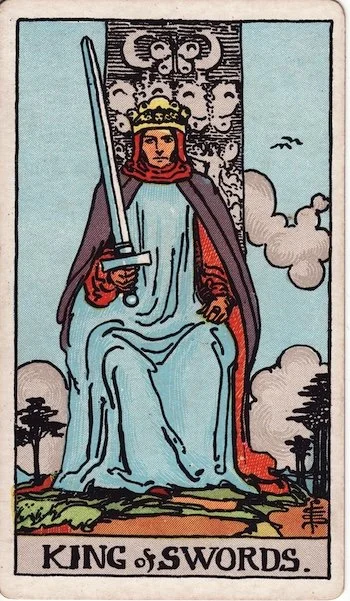
The King of Swords is the tarot's card of intellectual authority and ethical clarity: the mind free of wishful thinking, willing to see what is actually true and say it plainly.
Upright, he sits on a stone throne with his sword held perfectly vertical. Not raised in combat. Straight up: truth as axis, as the thing that orients everything around it. He stopped needing it to be something else. That is most of the work.
Reversed, the clarity has become weaponized, or the certainty has hardened into closed-mindedness.
This guide covers the full meaning of the King of Swords including love, career, shadow work, journal prompts, and affirmations.
Meeting the King of Swords
The King of Swords sat on a stone throne, upright and still, with his sword held perfectly vertical in his right hand.
Not raised in combat. Not resting. Straight up: the sword as principle, as axis, as the thing that orients everything around it.
The sky behind him was active: clouds moving, two birds in flight. The King himself was absolutely still. His eyes were direct without being aggressive. His face was entirely composed. Not cold, not warm. Simply clear.
There was something unfamiliar in his presence: the absence of any attempt to make the visitor comfortable.
Not cruelty. Just the absence of that particular kind of social smoothing that most encounters involved. The King of Swords was not trying to make anyone feel good. He was simply present: entirely honest, entirely himself, requiring nothing.
"Ask what you want to know," the King said. Not an invitation in the warm sense. Simply an offer: accuracy, freely given.
He found himself thinking carefully before speaking. Something about this presence made careless questions feel wasteful.
"How do you know what is true?" he asked finally.
The King considered this with genuine attention. "I stopped needing it to be something else," he said. "That's most of the work."
His authority was not the result of superior intelligence. It was the result of superior honesty: with himself, about everything.
Keywords for the King of Swords
Clarity
Intellectual authority
Honest judgment
The truth spoken plainly
Strategic thinking
Ethical integrity
The mind at its most precise
Wisdom through honest discernment
Associations
Element of Element: Fire of Air (the active, directing energy of Fire expressed through the sharp, clear, analytical nature of Air; the King of Swords does not merely think: he acts from thinking, directs from clarity, and uses the mind as a genuine instrument of authority and leadership)
Archetype: The Judge, The Strategist, The Ethical Authority, The Clear-Minded Leader
In a person: Someone with a razor-sharp mind, strong ethical principles, and the courage to say what is true even when it is difficult. A judge, a strategist, a lawyer, a doctor, a mentor whose honesty is the most valuable thing they offer: someone who does not soften the truth to make it easier to hear, but who delivers it with genuine integrity rather than cruelty.
As an energy: The energy of complete intellectual clarity: the mind free of wishful thinking, capable of seeing what is actually true and saying it plainly. The authority that comes from having developed and tested a set of principles and being willing to live by them even when it is inconvenient.
Card Symbolism
The Upright Sword: The sword held straight up is the card’s defining image — and it is importantly different from how swords appear in the rest of the suit. It is not raised in attack, not lying on the ground in defeat, not carried stealthily away. It points directly upward: truth as vertical axis, the principle that does not bend. The King of Swords’ authority is built on this quality. He says what is true. He does not angle it.
The Stone Throne: Hard, permanent, unadorned. The King of Swords does not sit on soft cushions or among flowers. His throne is stone because his authority is built on principle rather than sentiment. This is not a cold statement. It is simply accurate. The intellectual authority of this card has a different texture than the warmth of Cups or the generativity of Wands. It is solid, reliable, and built to last.
The Active Sky: Behind the King, clouds move and birds fly. The world is in motion; the mental realm is active and complex. The King himself is still within it — not above it, not untouched by it, but genuinely able to maintain his orientation even as things move around him. This is intellectual clarity in its practical form: not the absence of complexity but the capacity to navigate it without losing one’s bearings.
The Butterflies on the Throne: Small butterflies appear in the throne’s decoration — symbols of transformation and the life of the mind. Even the stone throne has something living in it. The King of Swords’ clarity is not static. It evolves, refines, and transforms through ongoing honest inquiry.
His Blue Tunic: Blue speaks to the mental realm, to clarity and truth. The King wears his element fully. His authority comes directly from this quality — not from warmth, not from fire, not from the depth of feeling, but from the precise, trustworthy functioning of a well-trained mind in service of genuine truth.
His Direct Gaze: He looks straight ahead. Not warmly, not coldly — directly. This is the gaze of someone who has nothing to hide and no agenda to advance. The King of Swords meets the world honestly because honesty is simply his natural orientation.
Upright Meaning
The King of Swords upright is the mind at its most fully realized: clear, principled, honest beyond convenience, and capable of the kind of precise judgment that genuinely serves rather than simply satisfies.
What distinguishes the King of Swords from the other Air court figures is the integration of sharp thinking with genuine ethical authority. The Page approaches truth with curiosity. The Knight pursues it with sometimes reckless speed. The Queen holds it with elegant, sometimes piercing precision. The King holds it with the full weight of tested, mature principle — and he acts from it with authority that has been earned through long practice.
This card marks the quality of a truly fair mind: one that has worked to eliminate the distortions of self-interest, wishful thinking, and social pressure from its judgments. The King of Swords does not tell you what you want to hear. He tells you what is true — and the distinction matters enormously in a world that often confuses the two.
In practical terms, this card appears when someone is operating from genuine intellectual clarity and ethical authority: making decisions based on principle rather than preference, offering counsel that is honest rather than comfortable, or using the precision of their mind in genuine service of something worth serving.
It can also mark a moment when clarity is specifically needed: a situation that requires the sword held straight up, the honest assessment made without flinching, the truth spoken even when the room would prefer something softer.
In evolutionary tarot, the King of Swords represents the full integration of the mind’s capacity: not intellect for its own sake, but the sharp, honest, principled thinking that becomes a genuine instrument of justice, wisdom, and compassionate truth-telling.
When you pull the King of Swords, ask: Am I seeing this clearly — meaning, without the distortions of what I want to be true — and am I willing to act from what I actually see?
King of Swords Reversed
The King of Swords reversed suggests that the clear, principled authority of the upright card has become distorted, usually toward the shadow expressions of a powerful and untempered mind.
King of Swords reversed key meanings:
Intellect weaponized: using sharpness and clarity to wound rather than to illuminate
Tyranny through principle: applying rules and judgments without compassion or contextual wisdom
The closed mind: certainty that has hardened into dogmatism, refusing new information
Manipulation through apparent logic: using the appearance of clear reasoning to justify predetermined conclusions
In some readings: legal difficulties, dishonest authority figures, or decisions made from cold calculation that lacks ethical grounding
The reversed King asks where the clarity is in service of truth and where it is in service of control.
Want to explore what this card means for your specific situation?
Book a private reading with Patrick →King of Swords in Love & Relationships
If you are in a relationship: The King of Swords in love brings honesty, clarity, and the rare quality of someone who means what they say and says what they mean. He does not perform warmth he doesn’t feel, and he does not obscure difficult truths with soft language. The question the card asks in a relationship context is whether the commitment to honesty is being held with compassion — whether the truth is being spoken in service of genuine connection, or whether it has become a way of avoiding the vulnerability that real intimacy requires.
If you are single: The King of Swords in a reading for someone single often signals intellectual clarity about what is actually wanted in partnership, distinct from what has been settled for or hoped might be enough. It can also indicate that someone carrying this energy is entering the picture: someone whose honesty is initially bracing but ultimately trustworthy, who means what they say about wanting to be here.
If you have experienced heartbreak: The King of Swords can appear after loss as the arrival of genuine clarity: the honest assessment of what the relationship actually was, stripped of the soft light of hope and memory. This is not cruelty — it is the necessary precision that eventually allows genuine healing and genuine movement forward.
King of Swords in Career & Finances
Career: The King of Swords is most powerful in professional contexts that require precise thinking, ethical judgment, and the courage to say difficult truths clearly: law, medicine, strategy, analysis, teaching, editing, leadership of any kind where decisions have significant consequences. He represents the professional whose honesty is the most valuable thing they bring — the advisor whose assessments can be trusted because they are not shaped by what the client wants to hear.
He also appears when someone needs to bring this quality to a situation in their current professional life: when a clear, honest assessment is available and being avoided, when a difficult decision is being deferred because clarity would make it impossible to avoid action.
Finances: Financially, the King of Swords brings rigorous honesty to money: the ability to look at numbers clearly, to make decisions based on what is actually true rather than what is hoped, and to maintain financial principles even when they are inconvenient. He does not make optimistic projections or avoid the hard parts of a financial picture. His relationship to money is as direct as his relationship to everything else.
King of Swords & Shadow Work
Where does my honesty become a weapon? The King of Swords’ clarity is most powerful when it is in genuine service of truth and the wellbeing of others. The shadow is the clarity deployed as a blade: the truth told not because it serves, but because it lands; not because it illuminates, but because it establishes superiority. The shadow work asks honestly whether the honesty in your life is kind, or whether it has sometimes been a sophisticated form of aggression.
Has my certainty become closed-mindedness? The King of Swords’ confidence in his own judgment is earned through genuine inquiry and long practice. The shadow is when that confidence hardens into an inability to be changed by new information — when the principle has become more important than the truth the principle was meant to serve. The shadow work asks when you last genuinely changed your mind, and whether the resistance you sometimes feel to other perspectives is intellectual integrity or intellectual defensiveness.
Am I using logic to avoid feeling? The mind can be the most sophisticated avoidance strategy available. The King of Swords’ shadow sometimes lives in the use of analysis, principle, and intellectual precision as a buffer against the emotional reality of a situation — the person who has a brilliant, accurate assessment of everything that is happening and is completely unreachable in the middle of it. The shadow asks what clarity is currently protecting you from feeling.
Is my ethical authority in service of the right, or of being right? There is a significant difference between standing on principle because it genuinely serves others and standing on principle because it preserves a self-image as someone who is always correct. The shadow work is in asking, with genuine honesty, which one is more active in your most recent difficult decision.
Tarot Academy
The Only Tarot Course You’ll Ever Need
Most tarot courses end at the cards: Tarot Academy takes you all the way. From learning all 78 cards in full depth, to developing your intuition, to launching a professional tarot practice.
King of Swords in a Tarot Spread
Past position: A period of clear, principled thinking or honest judgment in the past has shaped the current situation. Someone used the King of Swords’ clarity — with or without its wisdom — and the results of that clear-eyed action are part of what is present now.
Present position: Genuine clarity is available right now — or being required. The card asks you to bring the King of Swords’ full quality to the situation: honest assessment, principled judgment, the willingness to act from what you actually see rather than what you wish were true.
Future position: A situation ahead will require clear, honest judgment and the courage to act from it. Begin now to develop the inner clarity that the King of Swords requires: the willingness to eliminate wishful thinking from your assessments and to face what is true about the situation, yourself, and what the moment requires.
Obstacle or challenge position: The obstacle is either the clarity being avoided — the honest assessment that would make comfortable inaction impossible — or the clarity weaponized, cutting when it should be serving. Identify which is active and address it.
Outcome position: The situation resolves through honest, principled judgment: the clear assessment made, the difficult truth spoken, the decision taken from genuine intellectual integrity. The outcome may not be comfortable. It will be right.
Common Misconceptions About the King of Swords
“This card means I should be cold and detached.” The King of Swords is not cold. He is honest. The coldness sometimes associated with this card comes from confusing emotional detachment with intellectual clarity. The King of Swords at his best is deeply engaged — with truth, with principle, with the genuine wellbeing of those he serves. His clarity is a form of care, not the absence of it.
“This card only applies to intellectual or professional matters.” The King of Swords’ clarity is as relevant in emotional and relational territory as in intellectual domains. Honest, principled, clear-eyed engagement with the truth of a relationship, a loss, or an internal conflict is entirely within this card’s range. The sword cuts through wishful thinking everywhere it operates.
“Reversed means someone is lying to me.” The reversed King of Swords can indicate dishonesty in others, but it more often points to the shadow expressions of the card’s own qualities: closed-mindedness, intellectual weaponization, logic used to avoid feeling. Look inward before looking outward.
Cards That Relate to the King of Swords
Justice — Justice is the King of Swords’ Major Arcana counterpart: the same quality of clear, honest, principled judgment expressed at the archetypal level. Both figures hold the sword of truth. Together they represent the highest expression of the Swords suit’s potential: clarity in genuine service of what is right.
The High Priestess — The High Priestess represents the intuitive, receptive wisdom that complements the King’s analytical clarity. Together they describe two essential modes of knowing: the direct, precise judgment of the mind and the deep, inner knowing of the intuition. The wisest counsel draws on both.
Queen of Swords — The Queen of Swords is the King’s complement in the Air court: her piercing, elegantly precise clarity meeting his broad, principled authority. Together they represent the full expression of mature Air energy: sharp, honest, and in service of genuine truth.
Ace of Swords — The Ace of Swords is the first gift of clarity from which the King’s entire journey began. The King holds the same sword, now fully understood and deliberately wielded. Together they describe the full arc of the Swords suit: from the first breakthrough of clear seeing to its most mature and authoritative expression.
Five of Swords — The Five of Swords represents the shadow territory the King of Swords has moved through and integrated: the ego-driven use of sharpness, the winning that costs too much. Together they trace the arc from clever to wise, from sharp to just.
What To Do When You Pull the King of Swords
Say the true thing. Whatever situation has called this card forward, there is something that needs to be said clearly and honestly, and it has probably been deferred. The King of Swords asks you to say it: without excessive softening, without strategic omission, without the performance of certainty you don’t have. Just the true thing, plainly.
Make the assessment without distortion. Look at the situation in front of you — the relationship, the decision, the professional reality, the inner state — and describe it accurately. Not as you wish it were, not as it would need to be for the preferred outcome to remain available, but as it actually is. Write it down if that helps. The King of Swords’ clarity begins with honest description.
Act from principle, not from preference. Identify the principle at stake in the current situation and ask whether your planned action is actually consistent with it. The King of Swords makes no exceptions for himself. He holds himself to the same standard he applies to everything else.
Bring the clarity with compassion. The sword at its best cuts through to what serves. Before deploying the King of Swords’ directness in a situation involving others, ask: is this truth being told in service of their genuine wellbeing, or in service of my own sense of being right?
Journal Prompts for the King of Swords
What is currently true about your situation that you have been avoiding seeing directly? What does the honest assessment — without wishful thinking — actually reveal?
Think about a time you told a difficult truth with genuine integrity and care. What made that possible? What did it cost, and what did it produce?
Where does your clarity sometimes become a weapon? When has your honesty served your own need to be right more than it served the person you were being honest with?
The King of Swords stopped needing the truth to be something else. What truth in your life are you still needing to be different from what it is? What would it mean to stop needing that?
What is your relationship to being wrong? Can you change your mind without it costing you your sense of authority? What happens internally when new information contradicts a settled conclusion?
What difficult decision has been deferred because making it honestly would require acknowledging something you haven’t yet been willing to acknowledge?
Affirmations
“I see clearly and I act from what I see. The truth is available to me.”
“I speak honestly and with care. My clarity is in service of what genuinely helps.”
“I hold my principles with integrity and without rigidity. I am open to what is true.”
“I am not afraid of difficult truths. They are how I find my ground.”
“My mind is a precise instrument. I use it in service of what is right.”
Theme Song
The Knight of Swords (Reversed) by The Dear Hunter, 2015
About The Author
Patrick is a professional tarot reader, author, and educator offering online tarot readings and structured tarot education. His work approaches tarot as a mirror for self-reflection and lived experience. The wisdom of tarot is the wisdom of our lives.
Patrick helps students and clients develop a grounded, thoughtful relationship with the cards. One that strengthens intuition and self-trust. Based in Brooklyn, he works with clients and students around the world.
Tarot Academy
Want to learn to read this card, and every other card in the deck, with confidence? Tarot Academy is my complete digital course for those ready to go all the way with tarot. Covering all 78 cards, their symbolism, their patterns, and how to read them intuitively for yourself and others.
142+ videos. 37+ hours of instruction. One lifetime investment.
Learn More About Tarot Academy →
Book a Tarot Reading
Ready for a personal reading with Patrick? Recorded and live options available.