King of Cups Tarot Card Meaning
The King of Cups is the tarot's card of emotional mastery: not the absence of feeling, but the integration of it into genuine wisdom and compassionate authority.
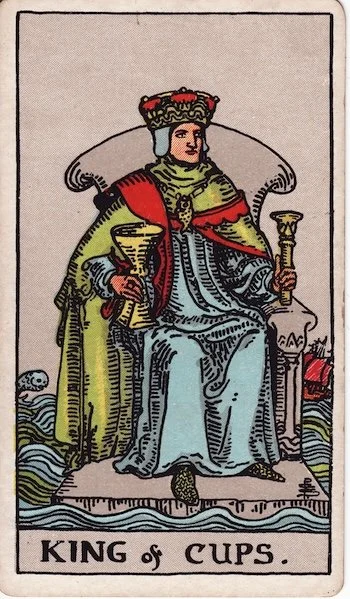
Upright, he sits on a stone throne in the middle of a churning sea. The water moves all around him. He does not move. He stopped trying to calm the sea a long time ago. He learned instead to hold his cup steady in the middle of it.
Reversed, the composure is suppression, or the emotional intelligence is being used to manage rather than to serve.
This guide covers the full meaning of the King of Cups including love, career, shadow work, journal prompts, and affirmations.
Meeting the King of Cups
The King of Cups sat on a stone throne in the middle of the sea.
Not at the edge of it, not near it. In the middle of it. The water moved all around him, restless and grey-green and full of its own agenda. Behind him, a fish leaped from the waves. A ship moved across the horizon. The world was in motion.
The King did not move.
He sat with a cup in one hand and a scepter in the other, and the expression on his face was the most complicated thing encountered on the entire journey: it was neither detachment nor suppression. It was something rarer: presence in the middle of motion. The quality of someone who is genuinely affected by the world and has learned, through long and difficult practice, that being affected and being swept away are not the same thing.
He sat down beside the churning water and looked at him.
"How do you do that?"
The King considered the question. "I stopped trying to calm the sea," he said at last. "That's most of it."
"What's the rest?"
"Learning to hold the cup steady without pretending the water isn't moving."
The cup in the King's hand: the surface of the liquid inside was still, despite everything.
Emotional mastery was not the absence of feeling. It was the capacity to feel everything without being defined by any of it.
Keywords for the King of Cups
Emotional mastery
Compassionate authority
Wisdom through feeling
The calm in the storm
Diplomatic maturity
Depth without drama
The counselor, the healer
Feeling without being swept away
Associations
Element of Element: Fire of Water (the active, directing energy of Fire expressed through the deep, feeling nature of Water; the King of Cups uses the warmth and conviction of Fire to direct his emotional wisdom: he does not merely feel, he acts from feeling with deliberate, compassionate authority)
Archetype: The Wise Counselor, The Emotional Elder, The Compassionate Leader, The Healer
In a person: Someone emotionally mature, deeply empathic, and genuinely wise about the human heart — a therapist, a mentor, a leader who leads with compassion and understanding rather than force. Someone who has been through enough emotional terrain to have earned their equanimity. Someone whose steadiness makes others feel genuinely safe.
As an energy: The energy of emotional depth fully integrated: feeling used as wisdom rather than liability, compassion that includes appropriate boundaries, the calm that comes not from suppression but from genuine knowledge of one’s own emotional landscape.
Card Symbolism
The Throne in the Sea: The King sits on a stone throne that appears to float in the middle of a turbulent sea. This is the card’s central and most important image: the stable, grounded figure in the middle of emotional turbulence. The throne does not sink. The King does not flee. He has made his seat in the middle of the water rather than at its edge: emotional mastery is not achieved by avoiding the depths, but by learning to be present within them.
The Cup: Held upright in his right hand. Unlike the other court figures who raise, offer, or examine the cup, the King simply holds it: steady, present, neither grasping nor displaying. This is the posture of someone whose relationship to emotion is established and at ease. He is not demonstrating his mastery of the cup. He is simply in possession of it.
The Scepter: In his left hand, a scepter — the symbol of authority and directed will. The King of Cups does not lead from emotion alone. He leads from emotion integrated with genuine authority. He feels deeply, and from that feeling he directs: counsels, decides, acts. The depth is not passive. It is a form of genuine power.
The Fish Necklace: Around his neck, a fish-shaped amulet. Fish in the Cups suit represent the subconscious, the depths of the emotional world, the things that move below the surface. The King wears one as an ornament — he has made peace with what lives in the depths. It decorates him rather than threatening him.
The Leaping Fish and the Ship: In the background, a fish leaps from the turbulent water — the unconscious breaking the surface — while a ship moves steadily across the horizon. Both exist in the same frame as the King, and both are acknowledged without disturbing his composure. This is the full picture of his emotional landscape: the unconscious is active, the journey continues, and he remains present through all of it.
His Blue Robe and Green Cloak: Blue speaks to the emotional realm, depth, and intuition. Green speaks to growth, life, and the generative. Beneath the authority of the scepter, the King is entirely clothed in his own emotional nature. His power is not separate from his feeling. It flows from it.
Upright Meaning
The King of Cups upright is the fullest expression of emotional mastery in the tarot: not the absence of feeling, but the integration of it into genuine wisdom and compassionate authority.
This card marks someone — or some quality of energy — that has been through the full range of emotional experience and has emerged with something rarer than happiness: genuine equanimity. The King of Cups has felt grief, desire, loss, joy, fear, and love in their full dimensions. He has not managed these experiences into smallness. He has stayed present through them long enough to understand what they were, and that understanding has become his authority.
What the King of Cups offers that none of the other Cups figures can is the quality of true presence in difficulty. The Page is sensitive but undefended. The Knight is ardent but sometimes destabilizing. The Queen is deeply empathic but her own depths can sometimes overwhelm. The King is all of these things and has integrated them into something functional: he can be present with another person’s pain without being flooded by it, can hold space for difficulty without needing to fix or manage it, and can feel the full weight of something without being buried under it.
In practical terms, this card often appears when someone is operating from this quality of emotional maturity — making decisions from a place of genuine wisdom rather than reactive feeling, offering counsel that comes from depth rather than theory, or leading in ways that honor the emotional reality of the people around them.
It also appears to mark a person in your life who carries this energy: someone whose steadiness makes you feel genuinely safe, whose compassion has genuine depth rather than surface warmth, and whose authority comes not from position but from the hard-won knowledge of what it means to be human.
When you pull the King of Cups, ask: Am I feeling from wisdom or reacting from wounding? And am I offering presence, or management?
King of Cups Reversed
The King of Cups reversed suggests that the integrated emotional mastery of the upright card has become blocked, bypassed, or distorted in one of several directions.
King of Cups reversed key meanings:
Emotional suppression masquerading as mastery: the calm that is actually numbness, the equanimity that is actually dissociation
Manipulation through emotional intelligence: using the knowledge of how others feel to influence or control rather than to serve
The wound running the show beneath a composed exterior: the unresolved emotional material that surfaces in unexpected and disproportionate ways
Moodiness, emotional volatility, or passive withdrawal in someone who usually presents as steady
In some readings: a person who appears emotionally wise and trustworthy but whose behavior eventually reveals that the depth is performed rather than genuine
The reversed King asks where the composure is coming from: genuine integration, or the suppression that will eventually surface.
Want to explore what this card means for your specific situation?
Book a private reading with Patrick →King of Cups in Love & Relationships
If you are in a relationship: The King of Cups in love brings the rare and genuinely valuable quality of emotional presence: the capacity to be with a partner in difficulty without needing to fix, minimize, or redirect it. He loves with depth, steadiness, and genuine attentiveness to the emotional reality of the other person. The question the card asks in a relationship context is whether the emotional wisdom is being shared openly, or whether the composure has become a kind of distance that keeps him safe from vulnerability.
If you are single: The King of Cups in a reading for someone single often signals emotional readiness: the inner work done, the old wounds no longer running the show, a genuine capacity for the depth of connection that real partnership requires. It can also signal that someone carrying this energy is entering the picture — steady, emotionally present, genuinely mature in their approach to intimacy.
If you have experienced heartbreak: The King of Cups is one of the most healing cards to receive after loss. It speaks to the emotional integration that eventually becomes possible after grief: not the absence of pain, but the arrival of a relationship to it that no longer requires avoidance. The cup is steady, even in the churning sea. The water has not stopped moving. But the King holds his ground.
King of Cups in Career & Finances
Career: The King of Cups is most powerful in professional contexts that require genuine emotional intelligence: counseling, therapy, leadership, teaching, medicine, diplomacy, creative direction, or any role where the capacity to hold space for others’ experience is itself the skill. He represents the professional who earns trust not through technical expertise alone but through the particular quality of their presence — the way they make people feel genuinely heard, genuinely seen, genuinely safe.
He also appears for those in leadership roles who are learning to lead with emotional intelligence: making space for the human dimension of their teams, making decisions that account for the emotional reality of those affected, and bringing the full depth of their own experience to the work rather than checking it at the door.
Finances: Financially, the King of Cups brings emotional maturity to decisions about money: the ability to make financial choices from long-term wisdom rather than short-term anxiety, to sit with financial uncertainty without being destabilized by it, and to bring the same quality of presence to the material dimension of life that he brings to the emotional one.
King of Cups & Shadow Work
Is my composure genuine, or is it suppression? The hardest shadow work of the King of Cups is in distinguishing between genuine equanimity — the calm that comes from having processed and integrated emotional experience — and emotional suppression, which looks identical from the outside but comes from a very different place. The shadow asks: when was the last time I was genuinely moved? When did I last let something reach me fully, rather than managing it from behind composure?
Am I using emotional intelligence to serve, or to control? The King of Cups’ deep understanding of how people feel is one of his greatest gifts. The shadow is using that understanding to manage, influence, or manipulate — to stay one step ahead of the emotional dynamics around him in ways that serve his own sense of safety rather than the genuine wellbeing of others. The shadow work asks honestly what the emotional attunement is for.
What am I still not willing to feel? Every version of emotional mastery has its edge — the territory that still feels too large, too old, too threatening to approach directly. The shadow work asks what remains unprocessed beneath the composure, what the King of Cups in you is still keeping at a careful distance, and what it would mean to finally sit with it.
Does my steadiness leave room for genuine vulnerability? The King of Cups is steady, but steadiness can become a form of armor. The shadow asks whether the people closest to you experience your composure as warmth or as distance, and whether your emotional availability is genuine or selectively deployed.
Tarot Academy
The Only Tarot Course You’ll Ever Need
Most tarot courses end at the cards: Tarot Academy takes you all the way. From learning all 78 cards in full depth, to developing your intuition, to launching a professional tarot practice.
King of Cups in a Tarot Spread
Past position: A period of emotional processing, integration, or genuine wisdom-building in the past has shaped your current emotional landscape. The equanimity available now was earned through something that required genuine presence and endurance.
Present position: You are being called to the King of Cups’ quality right now: emotional presence in the middle of difficulty, compassionate authority, the wisdom that comes from feeling without being swept away. The question is whether you are fully inhabiting that capacity or holding some of it in reserve.
Future position: A situation ahead will call for the King of Cups’ specific quality: the ability to hold space for difficulty without being destabilized by it, to lead from emotional wisdom rather than reactive feeling, to be steady when the people around you need steadiness. Begin now to tend the inner resources that quality requires.
Obstacle or challenge position: The obstacle is either the emotional experience not yet integrated — the wound still running the show beneath the composed surface — or the composure that has become distance, keeping the full depth of connection at arm’s length. Identify which and tend to it directly.
Outcome position: The situation resolves through genuine emotional maturity — the quality of presence, compassion, and wise, steady engagement that the King of Cups embodies. The outcome is not the absence of difficulty. It is the capacity to meet it fully.
Common Misconceptions About the King of Cups
“This card means I should suppress my emotions and be calm.” The King of Cups is not a card of emotional suppression. His composure comes from integration, not avoidance. He feels deeply — the sea is churning all around him precisely because the emotional world is fully present. What he has learned is not to stop feeling but to feel without being controlled by what he feels.
“The King of Cups is only relevant for therapists and counselors.” The King of Cups’ emotional wisdom is relevant in any context where genuine human presence matters: in parenting, in friendship, in partnership, in leadership, in any creative work that draws on the depths of human experience. The capacity to feel without being swept away, to hold space for difficulty without managing it into smallness, and to act from wisdom rather than reaction — these are universally needed qualities.
“Reversed always means emotional manipulation.” Manipulation is one possible expression of the reversed King of Cups, but it is far from the only one. Emotional suppression, unprocessed wounding, moodiness, and the composure that is actually numbness are all equally common reversal expressions. Context matters significantly with this card.
Cards That Relate to the King of Cups
The High Priestess — The High Priestess shares the King of Cups’ relationship to the depths: the knowledge of what moves beneath the surface, the capacity to sit with mystery without needing to resolve it. Together they describe two different but related forms of deep wisdom: hers intuitive and receptive, his active and compassionately directed.
Temperance — Temperance shares the King of Cups’ quality of balanced, integrated emotional wisdom — the patient, alchemical work of bringing opposing forces into sustainable harmony. Together they describe the inner architecture of genuine equanimity: not suppression, but the patient integration of all that has been felt.
Queen of Cups — The Queen of Cups is the King’s complement: where she embodies the full depth and receptivity of the emotional world, he embodies the directed, authoritative wisdom that flows from having navigated those depths. Together they represent the full expression of mature emotional intelligence.
Four of Cups — The Four of Cups is an earlier stage of the emotional journey that eventually produces the King: the turning inward, the withdrawal from the outer world, the necessary period of deep inner processing that precedes genuine integration. Together they trace the arc from emotional introversion to mature emotional authority.
Nine of Cups — The Nine of Cups represents the emotional fulfillment that the King’s long journey has produced: the wish genuinely realized, the satisfaction of a life that reflects genuine inner work. Together they describe the relationship between the process of emotional integration and the arrival it eventually produces.
What To Do When You Pull the King of Cups
Stop trying to calm the sea. The King’s central teaching. The emotional world will be what it is — turbulent, complex, full of its own agenda. The work is not to eliminate or suppress the turbulence but to develop the capacity to be present within it. Ask where you are currently expending energy trying to make your emotional world less than it is, and what it would mean to simply hold your cup steady in the middle of it.
Tend the inner resources that steadiness requires. The King of Cups’ equanimity is not free. It is the result of sustained inner work: the processing of old material, the development of self-knowledge, the practices of reflection and honest self-examination. Ask what those practices are for you — and whether you are currently maintaining them or running on old reserves.
Bring presence, not management, to difficulty. The next time someone in your life is in emotional difficulty, practice the King of Cups’ specific quality: being fully present with what they are experiencing without needing to fix, redirect, or resolve it. Notice what that requires of you, and what it produces in them.
Feel the thing you’ve been managing. At some point, every King of Cups needs to put down the scepter and pick up the cup with both hands. Ask what emotional experience you have been composing your way around rather than fully entering, and whether it might be time to give it the presence it has been waiting for.
Journal Prompts for the King of Cups
What is your relationship to your own emotional depth? Do you trust it as a form of wisdom, or do you manage it as a liability? Where did that relationship come from?
Think about a time when you were the King of Cups for someone else — fully present in their difficulty without needing to fix or change it. What made that possible? What did it cost you?
Where in your life is composure currently serving as distance? What are you keeping at arm’s length under the name of emotional maturity?
The King holds his cup steady in a churning sea. What is your churning sea right now — the emotional turbulence that surrounds you — and how are you currently relating to it?
What have you not yet fully allowed yourself to feel? What is waiting beneath the composure?
What would genuine emotional wisdom look like in the situation you are currently navigating — not the absence of feeling, but feeling used as a form of clarity and direction?
Affirmations
“I feel deeply and I am not swept away. My emotions are a form of wisdom.”
“I hold my cup steady. The sea does not determine my ground.”
“I offer genuine presence, not management. I am with people in their difficulty.”
“My composure comes from integration, not suppression. I have earned my calm.”
“I lead from the depths. My authority flows from what I have felt and understood.”
Theme Song
Heroes by David Bowie, 1977
About The Author
Patrick is a professional tarot reader, author, and educator offering online tarot readings and structured tarot education. His work approaches tarot as a mirror for self-reflection and lived experience. The wisdom of tarot is the wisdom of our lives.
Patrick helps students and clients develop a grounded, thoughtful relationship with the cards. One that strengthens intuition and self-trust. Based in Brooklyn, he works with clients and students around the world.
Tarot Academy
Want to learn to read this card, and every other card in the deck, with confidence? Tarot Academy is my complete digital course for those ready to go all the way with tarot. Covering all 78 cards, their symbolism, their patterns, and how to read them intuitively for yourself and others.
142+ videos. 37+ hours of instruction. One lifetime investment.
Learn More About Tarot Academy →
Book a Tarot Reading
Ready for a personal reading with Patrick? Recorded and live options available.