Five of Swords Tarot Card Meaning
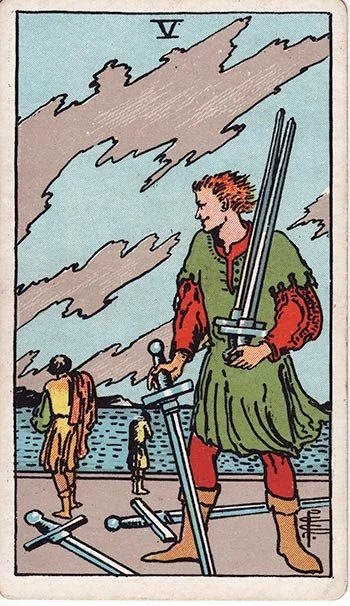
The Five of Swords is the tarot's card of the argument won at the wrong price: the conflict where the victory is real and what it cost is also real.
Upright, it arrives in the aftermath and asks you to look honestly at both. The swords are in your hands. The figures are walking away. The question the card poses, quietly and without judgment, is whether you'd choose the same fight again.
Reversed, a turning point in the conflict. Movement toward resolution, accountability, or the decision to disengage.
This guide covers the full meaning of the Five of Swords including love, career, shadow work, journal prompts, and affirmations.
Meeting the Five of Swords
The argument was over.
He stood on the hillside with three swords collected in his hands. The others were walking away. Their swords lay abandoned on the ground behind them, their shoulders curved inward in the particular posture of people who've lost something and aren't yet sure what.
He had won. He knew it. He could feel it in the weight of the swords, in the quiet that had replaced the noise, in the specific satisfaction of a position held.
And yet.
He stood there on the gray hillside and let the satisfaction settle, and underneath it he found something he hadn't expected: a question. Not a small one.
What exactly had he won? And what had the winning cost?
The figures walked away and kept walking. The distance between them and him grew. He looked at the three swords in his hands. More than he needed. More than he'd come here for.
The Five of Swords doesn't ask whether you won. It asks whether, looking at what it cost, you'd choose the same fight again.
Keywords for Five of Swords
Conflict
Ego battles
Pyrrhic victory
Winning at a cost
Betrayal
Manipulation
Self-interest
The aftermath of argument
Associations
The Element: Air (the mind, communication, truth — here operating at its most combative and self-serving)
Numerology: 5 (disruption, instability, the challenge that arrives to test what has been built — the Five of every suit marks a crisis point)
Planet: Venus in Aquarius (the desire for connection and harmony expressed through a detached, intellectualizing energy — the tension between wanting relationship and needing to be right)
Zodiac: Aquarius
Card Symbolism
The Central Figure: He stands with three swords, a slight smirk on his face — or at least a quality of satisfaction. He has won. But the way he holds the swords — collected, accumulated, more than any one person needs — speaks to something beyond self-defense. This is acquisition. This is the desire not just to prevail but to possess.
The Two Figures Walking Away: Defeated, retreating, one looking back. These are the people who lost this exchange — whether through argument, betrayal, or the simple exhaustion of conflict with someone who would not stop. Their posture is the emotional core of the card: this is what winning at this cost looks like from the outside.
The Discarded Swords on the Ground: Two swords lie abandoned — weapons that were held and then released in defeat. They represent what was given up: the argument, the position, perhaps the relationship itself. Once swords are dropped in this suit, they are not easily retrieved.
The Stormy Sky: Turbulent clouds over choppy water — the atmosphere of conflict that has not resolved, only ended. The storm hasn’t cleared. The air is still disturbed. Whatever happened here has left its mark on the environment.
The Smirk: The subtle expression on the central figure’s face is one of the most discussed details in the tarot. It is not joy. It is the particular satisfaction of someone who prioritized being right over being kind — and got what they came for, at some cost they may not yet be accounting for.
Upright Meaning
The Five of Swords upright is the card of the argument won at the wrong price.
This card arrives at the intersection of conflict and consequence — specifically, the moment when the dust has settled and the full picture of what just happened comes into focus. Someone prevailed. Words were used as weapons. A position was held or taken. And now the question the card poses — quietly, without judgment — is whether the victory was worth what it cost.
Sometimes the Five of Swords reflects your own behavior: the times you argued past the point of necessity, pressed an advantage you didn’t need to press, won a debate and lost a relationship in the same conversation. The swords in hand are real — you have what you fought for. The figures walking away are also real.
Sometimes it reflects someone else’s: a situation where you have been on the receiving end of conflict that felt less like honest disagreement and more like the desire to dominate. The Five of Swords appears in both positions — the one holding the swords and the one walking away — and asks both parties to examine what they are carrying from this.
In evolutionary tarot, this card is also a mirror for the battles we choose. Not every conflict deserves your full engagement. Not every argument is worth winning. The Five of Swords asks you to examine where you are spending your sword energy — and whether the victories you are pursuing are actually serving you.
Five of Swords Reversed
The Five of Swords reversed signals a turning point in the conflict — movement toward resolution, accountability, or the decision to disengage.
Choosing to walk away from a battle that isn’t worth fighting
Seeking reconciliation after a damaging conflict
Recognizing the cost of ego-driven victories and making a different choice
Being released from a toxic dynamic or ongoing power struggle
In some readings: conflict that has been suppressed and is building beneath the surface
The reversed Five of Swords asks: are you ready to put down the swords? Not in defeat, but in genuine discernment. Some battles end not when someone wins but when someone decides the whole thing isn’t worth continuing. That decision — when it comes from clarity rather than exhaustion — is one of the most mature moves this suit offers.
Want to explore what this card means for your specific situation?
Book a private reading with Patrick →Five of Swords in Love & Relationships
If you are in a relationship: The Five of Swords in a love reading points to a dynamic where conflict has become about winning rather than understanding. Arguments that escalate past the original point. The need to be right overwhelming the need to be connected. Words used in ways that leave marks.
This card can also indicate betrayal — a breach of trust, something said or done that cannot be unsaid or undone. In either case, the card asks: what is the fighting actually about? And is the relationship being protected by the conflict, or eroded by it?
If you are single: The Five of Swords can point to patterns carried from past relationships into the present — the armoring that happened after a betrayal, the hypervigilance around conflict, the tendency to argue preemptively. The card asks what you are still carrying from a fight that ended long ago.
If you have experienced heartbreak: Sometimes the Five of Swords appears after a relationship ends badly — betrayal, harsh final words, the kind of ending that felt like being one of those figures walking away. The swords are still present. The card asks when you will decide to stop carrying them.
Five of Swords in Career & Finances
Career: The Five of Swords in a career reading signals workplace conflict — power struggles, credit being taken, ideas dismissed or stolen, the particular toxicity of competitive environments where people prioritize advancement over integrity.
It can indicate a situation where you have been treated unfairly, or one where you have been the person who pressed an advantage past what was necessary. Both are worth examining. The card asks: is this environment bringing out the best in you, or is it teaching you to fight in ways that conflict with your values?
It can also signal that a workplace battle needs to end — that continuing to fight for a position, a project, or recognition in a particular environment is costing more than it’s worth, and that the wisest sword move is to put them down.
Finances: Financially, the Five of Swords can indicate a dispute, a loss through conflict, or a situation where someone has acted in bad faith. It asks for clarity about what is genuinely recoverable and what is better released than pursued.
Five of Swords & Shadow Work
The shadow of the Five of Swords lives in the relationship between the need to be right and the need to be loved — and in all the ways those two needs come into conflict.
Do I fight to win or to understand? The most clarifying shadow question this card offers. Honest examination of what you are actually trying to achieve in conflict — resolution, or victory? Connection, or dominance? The shadow lives in the gap between the answer you give and the answer that is true.
What do I do with the swords after the fight? The figure in the card is still holding the swords after everyone else has gone. The shadow asks: do you put them down when the conflict is over, or do you carry them into the next situation? Do you relitigate old arguments? Do you keep score?
Where does my need to win come from? The Five of Swords shadow almost always has a history. The hypercompetitiveness, the inability to back down, the need to have the last word — these patterns tend to come from somewhere specific. The shadow work is in finding that origin and examining what the winning has been protecting you from.
Who have I left walking away? The two figures in the card are the shadow’s most honest invitation. Who, in your life, has walked away from a conflict with you carrying wounds you inflicted? What did you take from them — and was it worth it?
Tarot Academy
The Only Tarot Course You’ll Ever Need
Most tarot courses end at the cards: Tarot Academy takes you all the way. From learning all 78 cards in full depth, to developing your intuition, to launching a professional tarot practice.
Five of Swords in a Tarot Spread
Past position: A conflict, betrayal, or ego-driven battle in the past has shaped how you approach disagreement now. Something was won at a cost, or you were on the losing end of someone else’s need to dominate. The pattern established there may still be operating.
Present position: You are in or just emerging from a conflict where the question of cost is live. The card asks you to look honestly at what is being won and what is being lost — not just in the external situation, but in yourself.
Future position: A conflict is ahead that will test your relationship to ego and winning. Begin now to clarify what you actually value in disagreement — resolution or victory — so that when the moment comes, you make the choice that serves you.
Obstacle or challenge position: The obstacle is the ego investment in being right — the inability to release a position even when holding it is causing more damage than the position is worth. The work is in developing the discernment to choose which battles deserve your full engagement.
Outcome position: The situation resolves, but not cleanly. Someone wins; something is lost. The card asks you to be honest about whether the outcome was worth pursuing in the way it was pursued.
Common Misconceptions About the Five of Swords
“This card means I’m going to lose a fight.” The Five of Swords can appear for the person holding the swords or the person walking away. It is not a prediction of loss — it is an examination of the cost of conflict, regardless of which side you are on.
“It always means betrayal.” While the Five of Swords can indicate betrayal, it more broadly speaks to any conflict where ego, self-interest, or the need to win has distorted the exchange. Not every Five of Swords is a betrayal — sometimes it is simply an argument that went too far.
“Reversed means the conflict is over.” The reversed Five of Swords can indicate resolution or the choice to disengage — but it can also point to conflict that has been suppressed rather than resolved. The swords are still there. The question is whether they have been genuinely put down or merely hidden.
Cards That Relate to the Five of Swords
Seven of Swords — The Seven of Swords shares the Five’s territory of self-interest and questionable integrity, but moves from open conflict into strategy and concealment. Where the Five is a confrontation, the Seven is a maneuver. Together they define the shadow range of the suit’s relationship to honesty and fair dealing.
Three of Swords — The Three of Swords is often what a Five of Swords situation leaves behind: the grief, the wound, the heartbreak of what was said or done. The Five is the conflict; the Three is its emotional aftermath. Together they trace the full arc of what damaging conflict actually costs.
Seven of Wands — Both cards deal in conflict and the defense of position, but the Seven of Wands asks you to hold your ground from genuine conviction. The Five of Swords is what happens when that defense becomes about ego rather than integrity. Together they define the difference between righteous defense and ego-driven combat.
Justice — Justice is the antidote to the Five of Swords — the card of honest reckoning, fair assessment, and accountability. Where the Five distorts conflict through ego and self-interest, Justice asks for the clear-eyed examination of what actually happened and what is actually owed. Together they define the spectrum between ego and integrity in conflict.
The Tower — When Five of Swords dynamics are sustained long enough without resolution, they tend to produce Tower moments — the sudden collapse of what was built on the unstable ground of ongoing conflict and unaddressed betrayal. Together they trace the arc from unresolved ego combat to the inevitable reckoning.
Journal Prompts for the Five of Swords
Think about a recent conflict. What were you actually fighting for — resolution, or being right? Be honest about the difference.
Who in your life has walked away from a conflict with you carrying wounds you inflicted? What do you carry from that? What would accountability look like?
Where do you confuse winning with safety? Where did you learn that being right was how you protected yourself?
What battles are you currently engaged in that you would benefit from disengaging from — not in defeat, but in discernment?
Think about a time you were on the losing end of someone else’s Five of Swords. What did that experience teach you about how you want to conduct conflict?
What would change in your most important relationships if you prioritized understanding over winning?
Affirmations
“I choose understanding over victory. Connection matters more than being right.”
“I am discerning about which battles deserve my energy and which do not.”
“I put down the swords when the fight is over. I do not carry them into what comes next.”
“Integrity in conflict is more valuable than dominance.”
“I can hold my truth without weaponizing it.”
Theme Song:
Bad Blood by Taylor Swift, 2015
About The Author
Patrick is a professional tarot reader, author, and educator offering online tarot readings and structured tarot education. His work approaches tarot as a mirror for self-reflection and lived experience. The wisdom of tarot is the wisdom of our lives.
Patrick helps students and clients develop a grounded, thoughtful relationship with the cards. One that strengthens intuition and self-trust. Based in Brooklyn, he works with clients and students around the world.
Tarot Academy
Want to learn to read this card, and every other card in the deck, with confidence? Tarot Academy is my complete digital course for those ready to go all the way with tarot. Covering all 78 cards, their symbolism, their patterns, and how to read them intuitively for yourself and others.
120+ videos. 25+ hours of instruction. One lifetime investment.
Learn More About Tarot Academy →
Book a Tarot Reading
Ready for a personal reading with Patrick? Recorded and live options available.