The Emperor Tarot Card Meaning
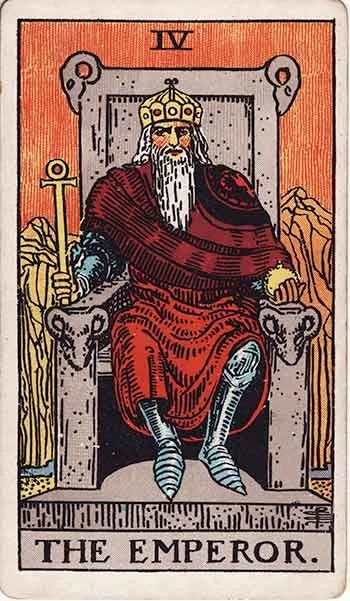
The Emperor is the tarot's card of authority, structure, and the discipline required to build something that holds.
Upright, he arrives when something in your life is asking for more structure than it currently has: the creative project without a plan, the situation without honest definition, the life direction without deliberate governance.
Reversed, authority has become distorted: either rigidity that crushes rather than contains, or abdication of the responsibility that the role genuinely requires.
This guide covers the full meaning of The Emperor including love, career, shadow work, journal prompts, and affirmations.
Meeting The Emperor
He sat on a stone throne at the edge of a mountain range, armored beneath his robes, perfectly still. The landscape behind him was barren. No lush garden here, no flowing river. Just rock and sky and the kind of silence that comes from having already built what needed to be built.
He did not speak first. He waited.
And in that waiting, something became clear: this figure did not need to perform his authority. He had earned it. Through discipline, through accumulated judgment, through the experience of having built structures that held and having watched structures that didn't. The stillness was not arrogance. It was the particular quiet of someone who had already answered the questions that were still being asked of everyone else.
The stone throne was uncomfortable. That was the point.
The Emperor's order was not the enemy of freedom. It was what made freedom durable. Without structure, abundance had nowhere to grow. Without walls, everything spilled out and nothing took root.
Keywords for The Emperor
Authority
Structure
Discipline
Fatherhood
Leadership
Order
Stability
Boundaries
Earned power
The builder
Associations
The Element: Fire (the will that initiates, the drive that builds — not the wild fire of the Wands but the controlled burn of sustained intention)
Numerology: 4 (the number of structure, foundation, and stability — the four corners that hold the room, the four walls that make a home, the four directions that orient a life)
Planet: Mars (the drive, the initiative, the force that moves through resistance — Mars builds what it claims and defends what it has built)
Zodiac: Aries (the initiator, the first sign, the archetype of someone who does not wait for conditions to be perfect before beginning — and who takes responsibility for what the beginning produces)
Card Symbolism
The Stone Throne: The Emperor does not sit on cushions. His throne is carved from stone — hard, permanent, uncomfortable in the way that earned authority is always uncomfortable. The throne represents the structure he has built: not inherited, not soft, not provisional. Something he sat down into after years of becoming the person the throne required.
The Ram Heads: Four ram heads decorate the throne — the symbol of Aries, the sign of the Emperor. The ram initiates. It does not wait to be led. The four rams speak to the Emperor’s fourfold nature: his authority extends in all directions, anchored in the cardinal energy of someone who acts rather than deliberates.
The Armor: Beneath his red robes, the Emperor wears armor. He is never fully at rest — ready for what must be defended, even in the moment of apparent ease. The armor is not paranoia. It is the realism of someone who has learned that what has been built must also be protected. The robes over the armor suggest that the force is present but does not need to be displayed.
The Scepter: The ankh-shaped scepter in his right hand — the ancient Egyptian symbol of life — represents the Emperor’s power not as domination but as life-giving authority. He holds the power to initiate, to grant, to direct. The right hand is the hand of action. He acts from this power without hesitation.
The Orb: The orb in his left hand represents the world under his governance — the scope of his responsibility. The left hand is the hand of reception. He holds the world’s weight not to display it but to remain conscious of it. Leadership is not the pleasure of authority. It is the weight of what you have chosen to be responsible for.
The Mountains: The barren mountain range behind him is the landscape of earned understanding — not the lush abundance of the Empress, but the stripped-down clarity of someone who has moved beyond needing the world to be comfortable. The mountains were climbed. They are now the backdrop. What once was obstacle is now context.
The Red Robes: Red is the color of Mars — vitality, action, the life force directed with intention. The Emperor’s red speaks to the energy beneath the structure: this is not a cold or lifeless authority. It is a living force that has chosen form. The discipline is in service of something alive.
The White Beard: The Emperor’s age is visible — the white beard is experience made legible. His authority is not the confidence of someone who has never been tested. It is the settled quality of someone who has been tested repeatedly and has built his judgment from the results.
Upright Meaning
The Emperor upright is the call to structure — to bring form, discipline, and conscious authority to what has been growing without direction.
This card is frequently misread as a card about control in the limiting sense — the rigid authority that crushes rather than contains. But the Emperor’s deepest gift is not control. It is the creation of the conditions in which genuine growth becomes possible. The Empress’s garden needs walls to become a garden rather than a wilderness. The Emperor provides those walls — not to imprison what grows inside them, but to give it somewhere to root.
When The Emperor appears in a reading, something in your life is asking for more structure than it currently has. The creative project that has been generating ideas without completing any. The relationship that has been proceeding without honest definition. The financial situation that has been managed by avoidance rather than intention. The Emperor asks: what would it look like to actually build this rather than continue gesturing toward it?
In evolutionary tarot, the Emperor represents the internalization of the father principle — not as a specific parent, but as the capacity to provide your own structure, your own discipline, your own authority over the direction of your life. The mature Emperor does not need an external authority to tell him what to do. He has developed his own internal governance — the ability to initiate, to sustain, to complete, to protect what he has built.
The Emperor is also the card of earned authority in the world — the leadership that comes from demonstrated competence and genuine accountability rather than from title or position. When this card appears in a professional context, it often signals the call to step into a leadership role honestly, which means accepting not just the authority but the full weight of responsibility that authority carries.
When you pull The Emperor upright: what needs to be built, structured, or governed more consciously in your life? And are you willing to be the one who builds it?
The Emperor Reversed
The Emperor reversed suggests that authority has become distorted — either by an excess of control, an abdication of responsibility, or a structure that has calcified past usefulness.
The Emperor reversed key meanings:
Authoritarian control that crushes rather than contains
Rigidity — the structure that was once useful has become an end in itself
Abdication of leadership: the refusal to take responsibility for what you have initiated
An external authority figure whose power has become domineering or destabilizing
Internal tyranny: the inner critic as emperor, the self-governance that has become self-punishment
In some readings: the invitation to dismantle a structure that no longer serves its original purpose
The reversed Emperor has two distinct faces, and it is worth knowing which one is present. The first is the tyrant — the authority that has forgotten it exists in service of something larger than itself, and has become self-referential, controlling, punishing. The second is the abdicator — the person who has authority, who has something that needs to be built and governed, and who consistently avoids the responsibility of doing so. Both are the Emperor’s energy out of alignment. The tyrant holds too tightly. The abdicator does not hold at all.
Want to explore what this card means for your specific situation?
Book a private reading with Patrick →The Emperor in Love & Relationships
If you are in a relationship: The Emperor in a love reading speaks to the structure of the partnership — whether it has the form, definition, and mutual accountability that allows it to function as something stable and real. This is the card that asks whether what exists between two people has been consciously built or simply allowed to accumulate. Conscious building requires honest conversation about expectations, commitments, and the kind of structure both people actually need.
It can also flag an imbalance of power — a relationship in which one person holds the Emperor’s authority while the other is positioned as a subject rather than a partner. Healthy Emperor energy in a relationship is protective and generative. Unhealthy Emperor energy is controlling and diminishing.
If you are single: The Emperor in a love reading for someone single often speaks to the internal work of authority — the development of the kind of self-governance and self-definition that makes genuine partnership possible. The person who has not developed their own Emperor is often unconsciously seeking that structure externally, in a partner who will provide the definition and direction they have not yet claimed for themselves.
The Emperor in Career & Finances
Career: The Emperor in a career reading is one of the most significant cards for professional life. It can signal a call to leadership — the invitation or the necessity of stepping into a role that requires genuine authority and accountability. It can also speak to the need to bring more structure to existing work: the project that needs a real plan, the business that needs real systems, the creative practice that needs real discipline.
This card also appears when someone is navigating a relationship with authority — a demanding boss, an institutional structure that feels constraining, or the experience of one’s own authority being questioned or undermined. In these contexts, the Emperor asks: where is your own authority in this situation? What structure can you build and maintain regardless of what the external authority does?
Finances: The Emperor’s financial message is structure and conscious governance. Budget, plan, build. The Emperor does not accumulate by accident — he accumulates through disciplined intention. In a financial reading, this card asks whether money is being managed with the deliberateness that the Emperor brings to everything he oversees. If not, it is time to bring his energy to bear.
The Emperor & Shadow Work
The shadow of The Emperor lives in the places where authority has become untethered from its original purpose — and in the places where authority has been refused entirely.
Where has my structure become rigidity? The Emperor’s shadow is the rules that have outlasted their usefulness, the discipline that has become an end in itself rather than a means to something alive. The work is in examining each structure honestly: does this still serve what it was built to serve? Or has maintaining it become a way of avoiding the discomfort of genuine change?
Am I governing myself or punishing myself? The inner Emperor can become the inner tyrant — the relentless self-criticism, the impossible standards, the voice that adds more rules whenever the existing rules are met. The shadow work is in distinguishing genuine self-discipline, which is generative, from self-punishment, which is a wound dressed up as virtue.
Where am I abdicating the authority that is genuinely mine? The reversed Emperor’s shadow is not excess control but its opposite: the consistent avoidance of responsibility for what you have initiated, what you have agreed to, what you have the capacity and the obligation to govern. The work is in naming where you have authority that you are not using — in your own life, in your relationships, in your work — and asking what it would mean to pick it up.
What is my relationship with my own father principle? The Emperor carries the weight of every person’s experience with authority — with fathers, with institutions, with the structures that were meant to protect and didn’t, or that protected by crushing. The shadow work is in separating the Emperor from his history: what does healthy, generative authority actually look like to you? Have you ever inhabited it? Can you imagine building it from the inside out?
Tarot Academy
The Only Tarot Course You’ll Ever Need
Most tarot courses end at the cards: Tarot Academy takes you all the way. From learning all 78 cards in full depth, to developing your intuition, to launching a professional tarot practice.
The Emperor in a Tarot Spread
Past position: A structure, an authority, or a figure of the Emperor’s type has shaped the current situation. The question is whether that inheritance is being carried consciously — whether the structure that was built or imposed in the past is still serving its purpose, or whether it has been outgrown and needs revision.
Present position: Structure, discipline, and conscious authority are called for right now. Something in your life needs to be built, governed, or taken responsibility for more deliberately. The Emperor in the present is not a comfortable card — it asks for sustained effort rather than inspiration.
Future position: A period of building, consolidation, and deliberate structuring is ahead. Begin developing the discipline and self-governance that this period will require. The Emperor in the future is not a warning — it is a preparation.
Obstacle or challenge position: The obstacle is either too much structure or not enough. Either a rigid authority is constraining what needs to grow, or the absence of structure is preventing what needs to take form. The Emperor as obstacle asks: is the problem that the walls are too high, or that there are no walls at all?
Outcome position: The situation resolves through the deliberate application of structure, authority, and accountability. What becomes possible when the Emperor resolves a situation is not comfort — it is the particular satisfaction of having built something that holds.
Common Misconceptions About The Emperor
“The Emperor is about domination or control.” The Emperor’s authority is, at its best, protective and generative — the structure that makes growth possible, the leadership that accepts responsibility for those it governs. Domination is the Emperor’s shadow, not his essence. The card asks for the kind of authority that serves something larger than itself.
“This card is only relevant for men or masculine energy.” The Emperor represents a set of inner qualities — discipline, structure, self-governance, the capacity to build and protect — that are available to and necessary for everyone regardless of gender. Every person has an inner Emperor. Every person needs access to that energy.
“The Emperor reversed always means a bad boss or controlling father.” The reversed Emperor can speak to those experiences, and they are worth acknowledging. But the card’s reversed energy is also pointing inward — to the places where your own authority is either too rigid or absent. The external tyrant and the internal abdicator are both faces of the same reversed card.
Cards That Relate to The Emperor
The Empress — The Empress and The Emperor are the tarot’s paired archetypes of the mother and father principles. Where the Empress is abundance, receptivity, and the generative power of nature, the Emperor is structure, authority, and the form that contains what grows. Neither is complete without the other. The garden without walls is wilderness. The walls without the garden are a prison.
The Hierophant — The Hierophant follows the Emperor and extends his energy into the realm of tradition, institution, and collective structure. Where the Emperor builds the personal and political order, the Hierophant builds the spiritual and cultural one. Together they speak to the two forms of external structure a life navigates: the civic and the sacred.
The Chariot — The Chariot is the Emperor’s energy in motion — the will that has been disciplined and directed toward a specific goal, the force that does not scatter because it has been given clear form. Together they speak to the relationship between structure and movement: the Emperor builds the form; the Chariot drives it forward.
Justice — Justice and the Emperor are both cards of structure and accountability, but they govern different domains. The Emperor governs through will and discipline. Justice governs through truth and consequence. Together they speak to the two pillars of genuine authority: the power to build and the honesty to reckon with what has been built.
Four of Pentacles — The Four of Pentacles is the Emperor’s energy in its shadow expression — the structure that has become holding on, the governance that has become hoarding. Where the Emperor uses authority in service of something larger, the Four of Pentacles uses it in service of the fear of loss. Together they trace the arc from generative structure to fearful rigidity.
What To Do When You Pull The Emperor
Name what needs to be built. The Emperor does not arrive to invite reflection. He arrives to invite construction. When this card appears, something specific is asking to be built — a plan, a system, a boundary, a commitment. Name it without softening it. What would actually taking responsibility for this look like?
Apply discipline before inspiration. The Emperor is not waiting to feel motivated. He sits on his stone throne and does what needs to be done regardless of how the morning feels. When this card appears, it is often pointing at the thing you have been waiting to feel ready for. The readiness comes from doing it, not from waiting. Pick up the scepter.
Examine your current structures honestly. Not all structure is the Emperor’s healthy expression. Some structures are habits that have become prisons, rules that have outlasted their usefulness, disciplines that are now forms of self-punishment. The Emperor asks for honest evaluation: what is being maintained because it still serves, and what is being maintained because dismantling it feels like failure?
Lead from accountability, not from authority. The Emperor’s most important quality is not that he holds power — it is that he holds it responsibly. When this card calls you to leadership, it is calling you to accountability first. The question is not what authority you can claim. It is what you are willing to be genuinely responsible for.
Journal Prompts for The Emperor
Where in your life does something need more structure than it currently has? What would deliberately building that structure require of you?
What is your relationship with authority — both the authority of others over you, and your own authority over your life? Where does that relationship need examination?
The Emperor wears armor beneath his robes. What are you protecting? Is what you are protecting worth the cost of maintaining that protection?
Where are you governing yourself versus punishing yourself? What does the difference feel like from the inside?
Think of the structures in your life — the systems, the habits, the commitments, the rules. Which ones still serve what they were built to serve? Which ones have outlasted their purpose?
What would it mean to fully accept responsibility for something you have been partially responsible for? What would change if you picked up that weight completely?
Affirmations
“I build what I initiate. I take responsibility for what I govern.”
“My discipline is in service of something alive. It does not exist for its own sake.”
“I lead from accountability. The weight of responsibility is one I choose to carry.”
“I provide the structure that makes growth possible — for myself and for what I build.”
“My authority is earned. I earn it again every day.”
Theme Song:
We Are The People by Empire of the Sun, 2014
About The Author
Patrick is a professional tarot reader, author, and educator offering online tarot readings and structured tarot education. His work approaches tarot as a mirror for self-reflection and lived experience. The wisdom of tarot is the wisdom of our lives.
Patrick helps students and clients develop a grounded, thoughtful relationship with the cards. One that strengthens intuition and self-trust. Based in Brooklyn, he works with clients and students around the world.
Tarot Academy
Want to learn to read this card, and every other card in the deck, with confidence? Tarot Academy is my complete digital course for those ready to go all the way with tarot. Covering all 78 cards, their symbolism, their patterns, and how to read them intuitively for yourself and others.
120+ videos. 25+ hours of instruction. One lifetime investment.
Learn More About Tarot Academy →
Book a Tarot Reading
Ready for a personal reading with Patrick? Recorded and live options available.