Seven of Pentacles Tarot Card Meaning
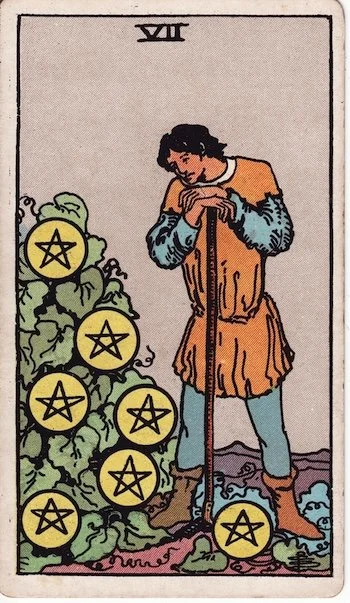
The Seven of Pentacles is the tarot's card of the honest assessment: the moment in any long-term project when enough has developed to look at clearly, and the quality of that honest looking will determine everything that comes next.
Upright, a figure leans on his hoe and looks at seven pentacles growing on the vine. Not with celebration or disappointment. With the honest gaze of someone who has been working long enough to know that enthusiasm is easy and endurance is the actual test.
Reversed, the patience has broken down or the honest assessment is being avoided.
This guide covers the full meaning of the Seven of Pentacles including love, career, shadow work, journal prompts, and affirmations.
Meeting the Seven of Pentacles
He stopped in the middle of the field and leaned on his hoe.
He'd been working for a long time. Not dramatically. Just consistently, the unglamorous daily kind of work that doesn't feel significant while you're doing it. The pentacles had grown slowly from the bush beside him, one by one, almost without his noticing. Now there were seven. Heavy, real, the evidence of sustained effort.
He looked at them.
Not with celebration, exactly. Not with disappointment either. With something more complicated: the honest assessment of someone who has been working long enough to know that enthusiasm is easy and endurance is the actual test.
Is this growing the way I thought it would?
Is what I planted still what I want to harvest?
Am I tending this out of genuine commitment, or out of the logic of someone who's already put in so much that stopping feels like failure?
The questions weren't anxious. They were necessary. This was the moment the work asked to be seen clearly. Not to be abandoned, but to be evaluated with the same care that had gone into planting it.
He rested his weight on the hoe and looked at the seven pentacles and let the questions be questions.
Growth is rarely dramatic. It's cumulative. The Seven of Pentacles asks whether you're willing to keep tending something that won't show its full yield for a while yet.
Keywords for the Seven of Pentacles
Patient investment
Long-term vision
Honest assessment
The pause before harvest
What your effort has actually produced
Sustainable growth
Waiting with purpose
Re-evaluation
Return on investment
The decision to continue or redirect
Associations
The Element: Earth (material reality, patience, the body’s knowledge of seasonal time, applied to the work of long-term building)
Numerology: 7 (reflection, inner wisdom, the pause that seeks deeper truth, applied not to philosophy but to the practical question of whether the work is working)
Planet: Saturn in Taurus (the patient, disciplined endurance of Saturn in the steady, material sign of Taurus: the understanding that significant things take significant time, and that the discipline to wait and tend is as important as the initial act of planting)
Zodiac: Taurus
Card Symbolism
The Figure Leaning on the Hoe: He is not actively working. He is pausing. The hoe is still in his hand; he hasn’t set it down completely or walked away from the work, but he has stopped the active labor to stand in assessment. This is the card’s defining posture: the pause that is not abandonment but reflection. The body leaning into the tool that has carried the work so far.
The Seven Pentacles on the Vine: The fruits of the labor, growing but not yet harvested. Seven — not three, not ten. Enough to be substantive. Enough to assess honestly. Not yet the full harvest, not yet the final tally. The pentacles invite the figure, and the querent, to look at what is actually there rather than at what was imagined.
The Vine: The vine is the vehicle of growth: the living organism that has been tended and that is doing the actual producing. The figure did not create the pentacles directly; he created the conditions for the vine to grow. This is the nature of long-term investment. You do not manufacture results. You tend the conditions that allow results to emerge.
The Earth Beneath His Feet: He is standing on the earth he has worked. This is not an abstract vision: it is grounded, physical, specific. The earth that was cleared, turned, planted, watered. The earth that knows the history of the effort. The Seven of Pentacles is always about what has actually been done, not what has been contemplated.
His Downward Gaze: The figure looks down: at the pentacles, at the vine, at the ground. Not at the horizon, not at what comes next, but at what is here now. The direction of his gaze is significant: this is the card of the present reckoning, the honest look at what the present moment actually contains. The horizon can wait. The vine needs to be seen clearly first.
The Yellow Background: Warmth and vitality: the light of a productive season. The conditions have been favorable enough to produce the vine. The environment has supported the growth. The question is what to do with what the favorable conditions have produced.
Upright Meaning
The Seven of Pentacles upright is the card of the honest assessment: the moment in any long-term project, relationship, investment, or creative endeavor when enough has developed to look at honestly, and when the quality of that honest looking will determine everything that comes next.
The figure has been working. The vine is growing. Seven pentacles are visible. The card marks the moment the Fool stops moving and starts looking, genuinely looking, with the clear eye that only sustained effort earns.
What has the work actually produced? Not what was planned. Not what was hoped for. What is actually growing on the vine? This is the first question the Seven of Pentacles asks, and it requires the kind of honesty that is easy to avoid when you’re still in motion. Staying in motion means never having to reckon with the results of your direction. The Seven of Pentacles calls the halt.
Is this enough — and enough for what? The seven pentacles are real. They are a genuine return on the investment of effort and time. The card does not dismiss them. But it does ask you to evaluate them honestly: Is this the pace of growth that the vision requires? Is this the kind of fruit that serves your actual needs? Has the vine been growing in the right direction, or is it beautiful but misaligned?
Should I continue or redirect? The most important question the Seven of Pentacles raises is the one about what comes next. Three possible answers: continue exactly as you are, because the vine is producing exactly what you need and the pace is right. Redirect — change the approach, the direction, or the investment of effort, because the results tell you something different is required. Harvest now — take what has grown, rather than waiting longer and risking the fruit. Each answer is valid. The card asks only that the answer be made from genuine assessment, not from inertia or impatience.
The card asks for the patience that honest long-term investment requires. The Fool is learning one of the Pentacles suit’s foundational lessons: significant things take significant time. The vine cannot be rushed. The harvest has its own season. The discipline of tending without forcing, of continuing the work without demanding premature results, is part of what the Seven of Pentacles teaches.
Seven of Pentacles Reversed
The Seven of Pentacles reversed typically signals a breakdown in the patience and honesty the upright card calls for, in one of a few different directions.
Impatience with the timeline: The work is genuinely progressing, but the pace feels intolerable. The gap between the current state of the vine and the imagined harvest is producing frustration that is risking the investment: the impulse to abandon or dramatically alter an approach that is actually working, simply because the waiting is painful.
Honest assessment avoided: The pause the upright card calls for is being skipped. The figure is still moving, still working, not stopping to look at the vine. The reversal asks: what are you afraid to see if you stop and look honestly? What truth is the continued motion protecting you from?
The work is not producing: In some readings, the reversed Seven of Pentacles confirms that the honest assessment would reveal a genuine problem: the vine is not growing the way it should, the return on the investment is not proportionate, the direction needs to change. The reversal here is not warning against premature assessment but calling for the honest reckoning that has been avoided.
Scattered investment: Effort spread too thin across too many vines, none of them receiving the sustained attention that would allow them to produce. The reversal asks for consolidation: where is your effort most likely to produce meaningful return, and are you giving that place enough of your resources?
Want to explore what this card means for your specific situation?
Book a private reading with Patrick →Seven of Pentacles in Love & Relationships
If you are in a relationship: The Seven of Pentacles in love asks for an honest reckoning with what the relationship has actually produced over time. Not the early visions of what it might become: the actual vine, the actual fruit, the actual quality of what has grown between you.
It can point to a natural pause in a long-term relationship: a moment of mutual assessment, a checking-in about whether the direction is still aligned, an honest conversation about what has been built and what it would take to build what you both actually want.
It can also point to a relationship where the honest assessment has been avoided, where the continued investment of energy and time and hope is proceeding without the pause that would allow both people to see clearly what the vine is actually producing.
If you are single: The Seven of Pentacles in a reading for someone single can point to the long-term work of building a life that will attract and sustain genuine partnership: the internal tending, the healing, the development of self-knowledge and clarity about what you actually need. The vine being tended here is the self.
It can also ask for honest assessment of a potential connection: not the dazzle of possibility, but the honest look at what is actually present, what the person has actually demonstrated, what the early interactions have actually produced.
If you have experienced heartbreak: After loss, the Seven of Pentacles can appear as an invitation to honest reckoning: the pause that allows you to look at the relationship you have left with clear eyes, to assess what it actually produced (growth, yes — and also what else?), and to take the information of that assessment forward into how you tend the next vine.
Seven of Pentacles in Career & Finances
Career: The Seven of Pentacles is one of the most important cards in a career reading: the card of the honest assessment of a professional investment, whether that is a business, a skill, a position, a creative practice, or any sustained professional effort.
It asks: given the time and energy you have invested, what are the results? Are they proportionate? Are they pointed in the direction of what you actually want? Is the pace of growth consistent with the vision, or has the vision drifted while the effort continued on autopilot?
The card is particularly significant for anyone running their own business, building a creative practice, or in a long learning curve. It marks the moment when the honest look at return on investment becomes essential, not to abandon the work prematurely, but to tend it more intelligently.
Finances: Financially, the Seven of Pentacles is a straightforward invitation to assess your long-term investments. The vine is growing: what is it growing? Are your savings, investments, and financial strategies producing the return you need at the pace the timeline requires? The card asks for the honest look that long-term financial health requires: not the hope of eventual results, but the clear-eyed assessment of current results.
It can also mark a decision point: continue investing, redirect, or harvest. The card honors all three as valid, asking only that the choice be made from genuine assessment rather than wishful thinking or avoidance.
Seven of Pentacles & Shadow Work
What am I afraid to see if I stop and look honestly? The shadow of continued motion: the staying-busy that protects you from the honest reckoning the pause would require. The figure in the card has stopped moving. The shadow work asks what makes stopping difficult, and what truth the motion is protecting you from encountering.
Am I staying invested in something because it is genuinely working — or because I can’t bear to accept that it isn’t? The sunk cost is one of the most powerful forces in human decision-making. The longer you have worked on something, the harder it is to acknowledge that the vine is not growing what you need. The shadow asks you to separate the value of the effort already invested from the question of whether future investment will produce a different result.
What would I plant if I started over with what I know now? Not a question designed to produce regret, but one designed to clarify values. The Seven of Pentacles is the honest assessment of the present. Part of that assessment is asking what you understand now that you didn’t understand when you planted the first seeds, and what that new understanding would change, if you let it.
Am I willing to harvest what I’ve grown — even if it isn’t what I planned? Sometimes the vine has grown something genuinely valuable that you are refusing to see because it isn’t what you expected. The shadow asks whether you are capable of recognizing and receiving what has actually been produced, rather than holding out exclusively for what was originally planned.
Tarot Academy
The Only Tarot Course You’ll Ever Need
Most tarot courses end at the cards: Tarot Academy takes you all the way. From learning all 78 cards in full depth, to developing your intuition, to launching a professional tarot practice.
Seven of Pentacles in a Tarot Spread
Past position: A past period of sustained effort and patient tending has shaped what is currently available. The vine that is growing now was planted then. The results being assessed now are the results of choices made earlier.
Present position: You are at the pause right now. The vine is growing, the pentacles are visible, and the honest assessment is available. The card asks you to make it, to look at what is actually there and to decide, from that honest seeing, what comes next.
Future position: A significant moment of assessment is ahead: a natural reckoning with the results of current investments. The card asks you to begin developing the capacity for honest evaluation now, so that when the pause comes, you can use it well.
Obstacle or challenge position: The obstacle is avoidance of the honest reckoning, either through continued motion (never stopping to look) or through impatience (looking too early, before the vine has had time to produce). The challenge is the pause that honest assessment requires.
Outcome position: The outcome involves a genuine reckoning with what the current trajectory is producing, and a decision made from honest seeing, about whether to continue, redirect, or harvest. The outcome is not a guaranteed harvest. It is the clarity that comes from actually looking.
Common Misconceptions About the Seven of Pentacles
“This card means I need to be more patient.” Patience is one teaching of the Seven of Pentacles, but it is not the only one. The card can equally be calling for the honest acknowledgment that patience alone won’t fix a vine that is growing in the wrong direction. Sometimes the assessment reveals that redirecting, not waiting longer, is what the situation requires.
“The seven pentacles mean I’m almost done.” The pentacles on the vine are not a countdown to a predetermined harvest. They are the current results of the current effort, available for honest assessment. They do not specify what the full harvest will look like, or whether the current trajectory will produce it.
“Reversed means the work isn’t worth continuing.” The reversed Seven of Pentacles can point to genuine problems with the investment, but it more often points to impatience, avoidance of honest assessment, or scattered effort. The direction first to look is internal.
Cards That Relate to the Seven of Pentacles
The Emperor — The Emperor shares the Seven of Pentacles’ investment in long-term building and the patient exercise of authority in service of sustained creation. Together they describe the combination of vision and discipline that significant material achievement requires.
Eight of Pentacles — The Eight of Pentacles is the dedicated skill-building that often precedes or follows the Seven’s honest assessment. Where the Seven pauses and evaluates, the Eight commits to the focused work that will actually develop the craft. Together they describe the full arc of sustained material investment: the assessment and the application.
Ten of Pentacles — The Ten of Pentacles is the fully realized harvest and generational abundance that the Seven of Pentacles’ patient investment is building toward. Together they describe the long view of material creation: the moment of assessment along the way, and the eventual realization of what the patient tending was always moving toward.
The Hermit — The Hermit shares the Seven of Pentacles’ orientation toward honest inner assessment: the willingness to pause, to look, to seek the truth that only clarity can produce. Together they speak to the value of the pause that is not passivity but deep, purposeful looking.
Three of Pentacles — The Three of Pentacles is the early dedicated effort: the mastery beginning to take shape, the craft being applied with skill and intention. The Seven of Pentacles is the honest assessment of where that effort has led. Together they trace the arc from skilled investment to mature evaluation.
What To Do When You Pull the Seven of Pentacles
Stop moving and look at the vine. This is the card's most fundamental instruction, and the one most often skipped. Actually stop. Write down honestly what the work you've been investing in has produced: specifically, measurably, in terms of what you actually need. Not what you hoped for. What is actually there.
Separate the value of past investment from the question of future investment. These are different questions, and the sunk cost has a way of answering the second question with the first. What you have already given to something, whether time, money, energy, or hope, does not determine whether continued investment is wise. Ask the future question on its own terms: if I were starting today, with what I know now, would I invest in this direction?
Make a conscious decision: continue, redirect, or harvest. The card asks for a chosen response, not a drifted one. Once the honest assessment is done, name what you are deciding. Continuing is valid — if the vine is growing and the pace is right. Redirecting is valid — if the assessment reveals a problem the current approach cannot solve. Harvesting is valid — if what has grown is genuinely ready to be received. The decision matters less than the consciousness with which it is made.
Identify one thing you would plant differently if you were starting now. Not to generate regret, but to generate clarity. What does the vine you have grown teach you about what you actually want, what you actually need, and what approach would serve you better going forward? The honest assessment is only useful if it informs what comes next.
Journal Prompts for the Seven of Pentacles
Look at the most significant long-term investment of your life right now — a relationship, a career, a creative practice, a personal goal. What is actually growing on your vine? Not what you hoped for — what is actually there?
What would you honestly assess about the return on the effort you’ve been putting in? Is the pace and quality of what’s growing proportionate to the investment you’ve made?
Is there something you have been continuing to tend out of inertia, out of the investment already made, out of the fear of admitting it isn’t working, rather than from genuine belief in its eventual harvest?
What would you plant, if you were starting from where you are now with what you know now? How different is that from what you are currently tending?
What does patience feel like in your body? Where is the line between productive patience (the vine needs time) and avoidance (continuing to invest in something that isn’t working because stopping feels like failure)?
When you imagine the honest reckoning this card calls for, stopping and looking honestly at the vine, what do you feel? What are you hoping to see? What are you afraid you might see?
Affirmations
“I pause and look honestly at what I have built. I trust what I see.”
“I tend my vines with patience and redirect with wisdom. I know the difference.”
“My effort is purposeful. I invest in what is genuinely growing.”
“I can honor the work already done and still choose a different direction if that is what is needed.”
“The honest assessment is a gift, not a threat. I welcome it.”
Theme Song:
“The Climb” — Miley Cyrus (2009)
About The Author
Patrick is a professional tarot reader, author, and educator offering online tarot readings and structured tarot education. His work approaches tarot as a mirror for self-reflection and lived experience. The wisdom of tarot is the wisdom of our lives.
Patrick helps students and clients develop a grounded, thoughtful relationship with the cards. One that strengthens intuition and self-trust. Based in Brooklyn, he works with clients and students around the world.
Tarot Academy
Want to learn to read this card, and every other card in the deck, with confidence? Tarot Academy is my complete digital course for those ready to go all the way with tarot. Covering all 78 cards, their symbolism, their patterns, and how to read them intuitively for yourself and others.
120+ videos. 25+ hours of instruction. One lifetime investment.
Learn More About Tarot Academy →
Book a Tarot Reading
Ready for a personal reading with Patrick? Recorded and live options available.