Knight of Swords Tarot Meaning: Ambition, Clarity & The Mind at Full Speed
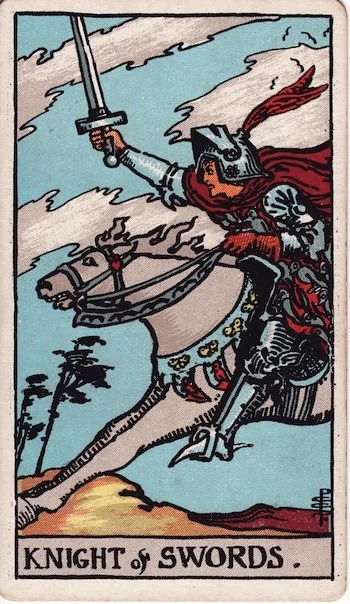
Knight of Swords, Rider-Waite-Smith Tarot Deck
Learn Tarot with That Oracle Guy Patrick. Together we’ll dive into the meanings, symbolism, and history behind each card, with affirmations, journaling prompts, and theme songs to help ground the lessons into your daily life. The wisdom of tarot is yours to claim — and if you're ready to go deeper, Tarot Academy was built for you.
Meeting the Knight of Swords
The Fool barely had time to step aside.
The Knight of Swords came at full gallop — not the measured pace of the Knight of Cups, not even the urgent momentum of the Knight of Wands, but something faster and more absolute. The horse’s mane whipped in a wind that seemed to exist specifically for this charge. The sword was raised high, pointing forward, the rider’s posture one of complete and total commitment to the direction he had chosen.
He was gone before the Fool could speak.
But he left behind a kind of turbulence — the trees bent sideways, the grass flattened, the air itself rearranged by the passage of something that had no interest in anything that stood in its way.
The Fool stood still for a moment, watching the distant figure disappear over the horizon.
He had noticed a few things in that brief, blazing passage. The Knight’s eyes had been fixed entirely forward — not down at the ground, not sideways at the landscape, certainly not back at anything left behind. The sword was raised not to threaten but to cut through: obstacles, delays, complexity, anyone who asked him to slow down.
The Fool had also noticed the clouds. They were dark and turbulent, churning behind the Knight like weather he was either creating or outrunning. It was hard to tell which.
He was remarkable. That much was clear. The focus, the speed, the absolute refusal to be deterred — there was something genuinely thrilling about that quality of commitment.
But the Fool found himself wondering about the things the Knight had ridden through without stopping. The things that had scattered in his wake. Whether any of them had needed consideration before being left behind.
The wind settled slowly. The trees straightened. The Knight of Swords was long gone.
Keywords for the Knight of Swords
Decisive action
Intellectual force
Speed and clarity
Single-minded pursuit
The cut that clears the way
Ambition
Truth-telling
The mind at full speed
Associations
Element of Element: Air of Fire (the suit of Swords — the mind, truth, communication, the capacity for clear and sometimes cutting thought — expressed through the Knight’s charging, forward-driving energy; the intellect that does not wait)
Archetype: The Crusader, The Intellectual Warrior, The Truth-Teller
In a person: Someone sharp, direct, fast-thinking, and intellectually formidable — a person who cuts through confusion and pretense with clarity, who communicates with force, and who pursues the truth or the goal with a single-mindedness that can be both inspiring and difficult to be around.
As an energy: The energy of the mind committed completely to a direction: fast, precise, cutting through obstacles with intellectual force, entirely focused on the forward charge and not on what is left in the wake.
Card Symbolism
The Full Gallop: The Knight of Swords moves faster than any other Knight in the deck. The horse is at full stretch, all four hooves off the ground at once. This is maximum velocity: the mind at its most committed, the decision made, the direction absolute. There is no slowing for second thoughts, no detour for the inconvenient complication.
The Raised Sword: The sword points forward, raised to cut through rather than simply to threaten. This is the mind’s edge applied to the world: cutting through confusion, cutting through obstacles, cutting through anything that would slow the charge. The sword of the Knight of Swords is always already in motion.
The Storm and Wind: Behind and around the Knight, the sky churns and the trees bend sideways in a fierce wind. The turbulence follows him, whether he is creating it, cutting through it, or indifferent to it, which is one of the card’s central questions. The Knight of Swords does not ride in calm weather. His energy has weather.
The Birds in Flight: Birds scatter from the trees as the Knight passes — startled, displaced, sent in different directions by the force of his passage. What is moved or disturbed in the Knight’s wake is part of what the card asks you to consider. The birds are not harmed. They are simply scattered.
The Decorative Butterflies on the Armor: Almost hidden amid the charging intensity, butterflies appear on the Knight’s armor as symbols of transformation. Beneath the fierce intellectual charge is a capacity for genuine change. The Knight of Swords at his best does not just cut; he cuts in service of something new becoming possible.
The White Horse: As with the Knight of Cups, the white horse speaks to purity of purpose and nobility of intention. The Knight of Swords is not cynical. He genuinely believes in the direction he has chosen and the truth he is pursuing. The charge is sincere.
Upright Meaning
The Knight of Swords upright is the card of the mind at full commitment: the moment when thinking has concluded and action has begun, when the analysis is complete enough and the sword is already raised and the horse is already moving.
This card appears when decisive intellectual action is called for: the direct conversation that has been avoided, the difficult truth that needs to be spoken, the decision that has been turned over long enough and now simply needs to be made and executed. The Knight of Swords does not do well with prolonged deliberation once the direction has become clear. He charges.
The quality that makes the Knight of Swords remarkable is the completeness of his commitment. When he moves, he moves entirely. There is no half-measure, no tentative approach, no foot left in the door of the previous position. The sword is raised, the direction is chosen, and everything in him is pointed at it. This totality of focus can be extraordinarily effective — problems that would take others weeks to untangle, the Knight of Swords cuts through in an afternoon.
What the card asks you to hold alongside this is the question of what the charge misses. Speed and clarity are gifts. They become costs when they move faster than the situation requires, when the commitment to a direction prevents honest engagement with new information, when the intellectual certainty is less certain than it appears.
When you pull the Knight of Swords upright, ask: What clarity has been building that is ready to be acted on — and what might be lost if it moves faster than it needs to?
Knight of Swords Reversed
The Knight of Swords reversed suggests that the decisive, clear-cutting energy of the upright card has become misdirected, excessive, or turned against itself.
Knight of Swords reversed key meanings:
Aggression that has lost its purpose: the sword cutting for its own sake rather than in service of genuine clarity
Intellectual arrogance: the certainty that one’s own analysis is correct and others’ perspectives are irrelevant
Scattered mental energy: the mind moving in too many directions at once, fast but without the unifying direction the upright card provides
The charge that has stalled: momentum blocked by obstacles, opposition, or the exhaustion of too much sustained intensity
In some readings: harsh words spoken without adequate consideration for their impact, or communication that prioritizes being right over being useful
The reversed Knight of Swords asks: what is the sword cutting that it should not be? And is the speed still serving the direction, or has it become the thing itself?
Knight of Swords in Love & Relationships
If you are in a relationship: The Knight of Swords in a love reading often speaks to communication patterns: the directness that can be enormously clarifying and the cut that can go deeper than intended. This card can mark a necessary direct conversation, something that needs to be said clearly and that has been avoided, or it can flag a pattern of intellectual force that leaves partners feeling steamrolled rather than heard.
If you are single: The Knight of Swords can appear when attraction is immediate, electric, and charged with the quality of two minds meeting. The intellectual connection is real and compelling. The card asks whether the depth is also there, and whether the Knight’s speed leaves room for the slower rhythms of genuine emotional intimacy.
If you have experienced heartbreak: The Knight of Swords can appear after loss as the return of mental clarity — the ability to think clearly about what happened, to cut through the fog of grief or confusion, to name what the relationship actually was. This is a genuine gift. The card asks that the clarity be honest rather than merely sharp.
Knight of Swords in Career & Finances
Career: The Knight of Swords in a career reading is a strong indicator for decisive professional action: the proposal made with confidence, the difficult conversation initiated, the decision executed without further delay. It supports directness, speed, and intellectual force. The card asks that the charge be aimed at something real rather than at the nearest obstacle.
It can also flag a pattern of professional abrasiveness: the communication style that prioritizes clarity and speed over relationship maintenance, the approach that is right more often than it is kind, and the cost that combination accumulates over time.
Finances: Financially, the Knight of Swords asks for decisive, clear-eyed engagement with the actual numbers. Cut through the avoidance, the optimistic fog, the complexity that has been used as an excuse for inaction. Know exactly where things stand and make the decisions that the honest picture requires.
Knight of Swords & Shadow Work
Is my certainty earned? The Knight of Swords moves with absolute conviction. The shadow asks whether that conviction is based on genuine analysis and complete information, or whether the speed of the charge has substituted for the depth of the investigation. The mind that moves too fast can arrive at certainty before the evidence actually supports it.
What am I cutting that doesn’t need cutting? The sword is always useful for something. The shadow asks whether it is being used with discrimination — applied where genuine clarity is needed — or whether it has become a reflexive response to anything that feels complicated, ambiguous, or in the way.
What is the weather I am creating? The trees bend and the birds scatter when the Knight rides through. The shadow work is in honest examination of the wake: what gets disrupted, displaced, or damaged in the force of the charge? Who has been on the receiving end of the directness, and what has it cost them?
What would it mean to be both right and kind? The Knight of Swords is frequently correct. The shadow is the belief that being correct is sufficient — that accuracy of analysis exempts the person from attention to how the truth is delivered, to whom, at what moment, and with what consideration for their capacity to receive it.
Knight of Swords in a Tarot Spread
Past position: A past charge — a direct conversation, a decisive action, a moment of forceful clarity — has shaped the current situation. What was cut through then is part of the landscape now.
Present position: Decisive action is called for right now. The clarity is present, the direction is clear, and continued deliberation is not serving the situation. The card asks you to raise the sword and move — with awareness of what the charge requires and what it costs.
Future position: A moment of clarity and decisive action is ahead. The intellectual force will be available when it is needed. Prepare by ensuring that when the sword rises, it is aimed with genuine discrimination rather than reflexive intensity.
Obstacle or challenge position: The obstacle is either the hesitation to be direct — the softening, the delays, the deferral of necessary clarity, or the excess of force that is creating more disruption than the situation requires. Identify which is operating.
Outcome position: The situation resolves through clear, direct action: the truth spoken, the decision made, the path cut through whatever has been obscuring it. The outcome has the quality of the Knight: fast, unambiguous, and clearing the way for something new.
Common Misconceptions About the Knight of Swords
“This card means I should be harsh or confrontational.” The Knight of Swords values clarity and truth, not cruelty. The sword cuts through confusion and pretense — it does not exist to wound. The directness this card calls for is in service of genuine clarity, not the satisfaction of being cutting.
“The Knight of Swords is the most powerful card in the deck.” The Knight of Swords has a specific quality of power: intellectual force and decisive momentum. This power is genuinely valuable in contexts that call for it and counterproductive in contexts that require patience, nuance, or emotional attunement. No single quality of energy serves every situation.
“Reversed means I need to think more before acting.” Sometimes. But the reversed Knight of Swords can also indicate that the charge has been blocked or stalled, that the mental energy is scattered rather than directed, or that the sword has been turned inward as self-criticism rather than outward as action. The specific expression of the reversal requires honest contextual reading.
Cards That Relate to the Knight of Swords
Page of Swords — The Page of Swords is the intellectual curiosity and sharp awareness before it found its direction: watchful, questioning, gathering information. The Knight is what that awareness becomes when it commits to a charge. Together they trace the arc from alert perception to decisive action.
Queen of Swords — The Queen of Swords is the intellectual clarity matured: precise, discerning, wielding truth with both sharpness and wisdom. She is what the Knight’s force becomes when it learns to choose when and how to cut rather than always charging. Together they describe the development of the Air element from momentum to sovereign judgment.
The Chariot — The Chariot shares the Knight of Swords’ quality of unstoppable forward momentum driven by sheer force of will. Where the Knight acts from conviction, the Chariot acts from command. Together they describe two expressions of the same quality: the passion that charges and the will that controls.
Ace of Swords — The Ace of Swords is the gift of clarity and truth from which the Knight’s charge flows. The Ace is the pure potential of the mind’s edge; the Knight is that edge in full motion. Together they trace the beginning of the Swords suit’s journey: from the gift of clear perception to its fullest, most committed expression.
Justice — Justice holds the sword the Knight charges with, but holds it still, weighing carefully before it falls. Together they describe the full spectrum of the sword’s use: from the measured, deliberate application of Justice to the committed, charging application of the Knight.
What To Do When You Pull the Knight of Swords
Make the direct communication. If there is a conversation that has been building — one that requires clarity, honesty, and the willingness to say the difficult thing — this card asks you to stop deferring it. The directness serves everyone involved more than continued avoidance does.
Act on the clarity you already have. The Knight of Swords does not wait for more information once the direction is clear. If the analysis is complete enough, stop deliberating and move. The decision that keeps being postponed in search of more certainty is often waiting for a certainty that will never fully arrive.
Check the temperature of the charge. Before the sword rises, spend a moment ensuring the force is proportionate to what the situation actually requires. Not every obstacle requires a full cavalry charge. Some require the sword’s precision applied gently. The difference is worth a moment’s consideration.
Stay open to what the charge reveals. The Knight of Swords moves so fast that he can miss what the movement itself is showing him. Build in a brief pause after decisive action to assess what the charge revealed — what new information appeared, what was more or less solid than expected, what adjustments the honest assessment of the wake requires.
Journal Prompts for the Knight of Swords
What clarity has been building in you that you have not yet acted on? What has the delay been about — genuine need for more information, or familiar hesitation in the face of what the clarity actually requires?
Think about a time when your directness cut something that didn’t need cutting. What happened? What would a more considered approach have looked like without sacrificing the essential truth?
What is your relationship to being right? Is there a cost you pay for always needing to be the fastest, sharpest, most certain person in the room?
What is the turbulence you create in your wake? Who or what gets scattered when your charge comes through? Is that a price you are willing to own?
Where in your life does the intellectual certainty feel more like armor than genuine clarity? What would it mean to allow yourself to not know?
What truth are you currently carrying that needs to be spoken — and what is making you hesitate to speak it?
Affirmations
“I act on my clarity with precision and purpose. The sword serves truth, not force.”
“I am direct and I am kind. These are not opposites.”
“I move when the direction is clear. I trust the analysis I have done.”
“I am aware of my impact. I charge with intention, not indiscriminate speed.”
“My intellectual gifts are in service of something real. I use them with care.”
Theme Song
Highway to Hell — AC/DC, 1979
About The Author
Patrick is a professional tarot reader, author, and educator offering online tarot readings and structured tarot education. His work approaches tarot as a mirror for self-reflection, and as lived experience. The wisdom of tarot is the wisdom of our lives.
Patrick helps students and clients develop a grounded, thoughtful relationship with the cards; one that strengthens intuition and self-trust.
Based in Brooklyn, he works with clients and students around the world, and considers this work his purpose.
Tarot Academy
Want to learn to read this card, and every other card in the deck, with confidence? Tarot Academy is my complete digital course for those ready to go all the way with tarot — covering all 78 cards, their symbolism, their patterns, and how to read them intuitively for yourself and others.
120+ videos. 20+ hours of instruction. One lifetime investment.
Learn More About Tarot Academy →
Book a Tarot Reading
Ready for a personal reading with Patrick? Recorded and live options available.
The Tarot Circle:
A private monthly membership for ongoing guidance, reflection, and ritual. Limited to 20 members, maximum.
Frequently Asked Questions
Can I learn to read tarot myself? Absolutely. It's a skill like anything else: it just takes study, practice, and determination. Tarot Academy was built exactly for this.
Is tarot right for me? Tarot reading is the practice of interpreting symbols and archetypes to better understand life situations, emotional patterns, and decision points. It is less about prediction and more about intuitive clarity and perspective.
Is tarot about predicting the future? Not at all. Tarot highlights current energies, influences, and themes unfolding now — and helps you navigate them consciously. Your future is always shaped by your choices.
Do I need to be spiritual to get a tarot reading? No. All you need is an open mind and good intention. I'll handle the rest.