Five of Cups Tarot Card Meaning
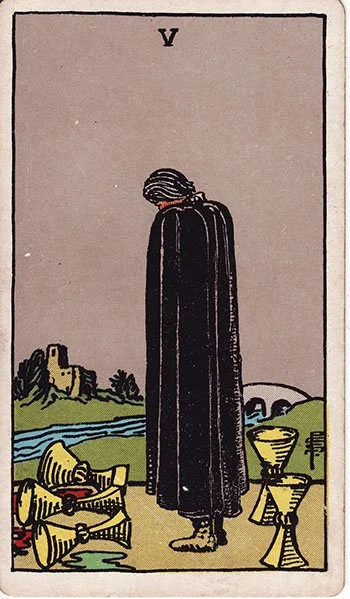
The Five of Cups is the tarot's card of grief being fully inhabited: the focus on what has been lost before the turn toward what remains.
Upright, it signals the sustained heavy middle of loss. The two standing cups are there. But the three fallen ones require honest, unhurried acknowledgment first.
Reversed, the grief is moving: beginning to release, beginning to heal, or in some readings, being suppressed before it's had the chance to complete.
This guide covers the full meaning of the Five of Cups including love, career, shadow work, journal prompts, and affirmations.
Meeting the Five of Cups
Three cups had fallen. Their contents were spilled across the ground, dark and irretrievable.
He stood before them in a black cloak, head bowed, back to everything else. He wasn't dramatic about it. He was simply there, inside the loss, in the particular way that genuine grief occupies a person completely.
Two cups stood behind him. Still full. Still standing. He couldn't see them. He wasn't ready to see them.
This was what the card asked to be understood: the turned back wasn't weakness. It was necessity. Grief that isn't allowed to be itself, that is rushed toward the standing cups before it has finished falling, doesn't resolve. It waits.
He stood with the figure for a long moment. He didn't offer comfort. He didn't point to the cups behind.
He knew enough to know that the timing of that gesture matters enormously. Offered too early, it becomes a dismissal of the grief rather than a companion to it.
He held the knowledge of the two cups. He kept it ready.
Grief, fully felt, eventually exhausts its need to be the only thing in the frame. The figure would turn. Not because the loss would become smaller. But because the heart, having honored it completely, would be ready to carry it differently.
Keywords for Five of Cups
Grief
Loss
Mourning
Focus on what was lost
Regret
The cups still standing
The turn toward what remains
Sorrow that asks to be felt
Associations
The Element: Water (emotion, feeling, the inner life — here, the emotional life in its most difficult expression: genuine loss)
Numerology: 5 (disruption, change, challenge — the five in all suits marks the point where the stability of the four is disturbed, where loss enters)
Planet: Mars in Scorpio (the drive and intensity of Mars expressed through Scorpio’s deep, transformative waters — grief that is total, that goes all the way down)
Zodiac: Scorpio
Card Symbolism
The Three Spilled Cups: On the ground, their contents poured out, irretrievable. Three cups — more than half of what was held. The loss is real and significant. This is not a minor inconvenience; it is a genuine loss of something that mattered. The card does not minimize what has been spilled. It honors it as the object of the grief it depicts.
The Two Standing Cups: Behind the figure, upright, full, waiting. They have not been noticed. They are not the focus of the grief — and in this phase of loss, they cannot be. But they are there. This is the card’s most important structural truth: even in genuine loss, something remains. The two cups are not a consolation prize or a silver lining forced onto pain. They are simply the honest picture of what is actual: some things were lost, and some things were not.
The Cloaked Figure: Black cloak, head bowed, turned away from the standing cups and toward the fallen ones. The posture is unmistakable — this is the body language of grief. Not dramatic or performed, but internal, contracted, the body turning inward around the loss. The cloak says: the world outside has grown dark. The figure is living inside the loss right now.
The River: Moving behind the figure, continuous, unhurried. Life continues. The river does not stop for the grief, does not acknowledge it, does not offer comfort or condemnation. It simply flows. The Five of Cups exists within the ongoing world — the grief is real and the world is indifferent to it, and both of those things are true simultaneously.
The Bridge: In the background, crossing the river — the way back to the other bank, to the town, to life and connection and forward movement. The bridge is there. The figure has not taken it yet. But its presence matters: the path back is available. The isolation of the grief is not permanent.
The Gray Sky: Heavy, overcast. The world of the Five of Cups is not warm or bright. The grief has colored everything. This is accurate to the experience — during acute loss, the quality of the light genuinely seems different, the world genuinely seems heavier. The card honors that perceptual reality without either endorsing it as permanent or dismissing it as irrational.
The Distant Town: Life happening at a distance. People, activity, connection — all still there, all still real, but not yet accessible from where the figure stands. The Five of Cups does not pretend that the world does not exist beyond the grief. But it acknowledges that grief, at its most acute, creates its own geography.
Upright Meaning
The Five of Cups upright is the card of grief being fully inhabited — the focus on what has been lost before the turn toward what remains.
This card arrives in the middle of loss — not at its beginning, not at its resolution, but in the sustained, heavy middle of it. The three cups are already spilled. The grief is already underway. What the card depicts is the particular phase of mourning where the loss fills the entire frame, where the two standing cups behind cannot be seen from where the person currently stands.
What the Five of Cups most specifically honors is the legitimacy of grief. The loss is real. The spilled cups were real. The grief that fills the frame is proportionate to what was lost, and it deserves to be felt — not managed, not reframed, not accelerated through. The card does not rush toward the two standing cups. It stands with the three fallen ones first.
At the same time, the two standing cups are present in the image — and their presence is not accidental. The Five of Cups does not say that everything was lost. It says that some things were lost and some things were not, and that in the acute phase of grief the partial nature of the loss is genuinely hard to see. The card honors both: the reality of what is gone and the eventual possibility of noticing what remains.
In evolutionary tarot, this card often appears as permission — permission to be in the grief, to let it be the whole picture for now, to resist the pressure to find the silver lining before the loss has been genuinely honored. And as a gentle, patient holding of the truth that the two cups are there, waiting, for when the person is ready to turn.
When you pull the Five of Cups upright, ask: What have I lost that I haven’t fully allowed myself to grieve — and what might I be missing while my eyes are on the spilled cups?
Five of Cups Reversed
The Five of Cups reversed suggests the grief is moving — the figure is beginning to turn, or has turned, toward what remains.
Five of Cups reversed key meanings:
Beginning to see what was not lost — the two standing cups coming into view
Recovery and renewal after a period of acute grief
Moving from grief toward acceptance and forward motion
The bridge being crossed — return to community, connection, and engagement with life
In some readings: grief being suppressed rather than processed — the turn away from the loss before it has been genuinely felt
The reversed Five of Cups asks: is this a genuine turn, or a premature one? There is meaningful difference between the natural movement out of grief — when the loss has been genuinely honored and the remaining cups can finally be seen — and the protective turning away from grief before it has been felt. The reversal is most often a positive sign. But if the three cups were never fully acknowledged, the reversal may indicate avoidance rather than resolution.
Want to explore what this card means for your specific situation?
Book a private reading with Patrick →Five of Cups in Love & Relationships
If you are in a relationship: The Five of Cups in a love reading often speaks to loss within the partnership — something that was hoped for and did not come to pass, a version of the relationship that no longer exists, a chapter that has ended within the ongoing connection. The grief here is not necessarily about the relationship ending, but about something within it being genuinely lost.
The card asks: what are you mourning within this relationship? And equally: what is still standing that you cannot currently see because the focus is on what fell?
If you are single: The Five of Cups in a love reading for someone single often points to the grief of a past relationship still present — the loss that has not yet been fully processed, the love that ended and whose ending still colors how the person approaches new connection. The three spilled cups are the old love. The two standing cups are what becomes possible once the grief has been genuinely honored.
If you have experienced heartbreak: This card is the honest companion of acute heartbreak — not the sharp wound of the Three of Swords, but the heavy, sustained grief of the aftermath. The figure’s posture, the gray sky, the distant town — all of it reflects the actual experience of significant loss. The card does not minimize it. And it holds the two standing cups, patient and full, for when the figure is ready to turn.
Five of Cups in Career & Finances
Career: The Five of Cups in a career reading marks a professional loss — a job not received, a project that failed, a career direction that did not work out, a professional relationship that ended badly. The grief of professional loss is real and is sometimes underacknowledged — the culture that surrounds career tends to move quickly toward what’s next rather than honoring what was genuinely lost.
The card asks for the grief to be honored before the pivot. Not interminably — but genuinely. And it asks what might still be standing that cannot currently be seen from the position of focusing on what fell.
Finances: Financially, the Five of Cups can speak to financial loss that carries emotional weight — the investment that failed, the savings depleted, the financial foundation that did not hold. The grief of financial loss is often compounded by shame, which makes genuine processing more difficult. The card asks for honest, non-shaming acknowledgment of what was lost — and for the patience to eventually notice what remains.
Five of Cups & Shadow Work
The shadow of the Five of Cups lives in the extended residence in the position of the grieving figure — the maintenance of the posture beyond its necessary duration, and what that extended staying protects against.
Am I honoring grief or using it? Grief is real and requires real time and real attention. But grief can also become a residence — a place to live rather than a process to move through. The shadow of the Five of Cups is the person who has made their home in front of the three spilled cups, who has come to identify with the loss so thoroughly that turning toward the two standing cups would feel like a betrayal of what was lost. The shadow work is in examining honestly: is this grief still being processed, or has it become a way of being?
What am I protecting by not turning around? The two cups behind the figure represent what remains, what is possible, what life still holds. To turn toward them is to acknowledge that the loss, however real and significant, is not the whole story — and for some people, that acknowledgment is frightening. If the loss is the whole story, certain things remain true: I am a victim of what happened, I cannot be expected to rebuild, the damage justifies the stasis. The shadow work is in examining what the extended focus on the spilled cups is protecting.
What would I have to become if I turned around? The two standing cups hold something — possibility, connection, the next chapter, whatever it is that is still available. Turning toward them requires becoming someone who is moving forward, someone for whom the loss is part of the story rather than the whole of it. The shadow asks: what would be required of me if I let what remains begin to matter?
Is there grief I have been skipping? The shadow of the Five of Cups can also run in the opposite direction — the person who cannot allow themselves to be in front of the spilled cups at all, who moves immediately to the two standing cups as a way of avoiding the genuine weight of the loss. The shadow work here is in acknowledging that the premature turn toward what remains is also a form of avoidance — one that will catch up in other ways.
Tarot Academy
The Only Tarot Course You’ll Ever Need
Most tarot courses end at the cards: Tarot Academy takes you all the way. From learning all 78 cards in full depth, to developing your intuition, to launching a professional tarot practice.
Five of Cups in a Tarot Spread
Past position: A significant loss, and the grief that followed it, has shaped who you are and how you approach what matters to you. The three spilled cups are part of your history — not something to be ashamed of, but something to acknowledge honestly as part of what formed you.
Present position: You are standing before the spilled cups right now — in the genuine middle of grief. The invitation is to honor the loss fully before looking for what remains. The two cups are there when you are ready. They will wait.
Future position: A period of grief or loss is ahead — something will be spilled. Begin now to build the relationship with loss that will allow you to honor it genuinely without making it a permanent residence.
Obstacle or challenge position: The obstacle is the sustained focus on what was lost at the expense of what remains — the grief that has become a home rather than a passage. The path forward involves both honoring what was lost and eventually turning to notice what is still standing.
Outcome position: The situation resolves through the turn — when the grief has been genuinely honored and the figure finally turns to see the two cups still standing. What becomes visible after genuine mourning is genuinely valuable. The bridge is there. The town is there. What remains is real.
Common Misconceptions About the Five of Cups
“This card means wallow in self-pity.” The Five of Cups depicts genuine grief, not self-pity. The distinction matters. Grief is the honest response to real loss. Self-pity is the extended residence in the position of the victim beyond what the loss warrants. The card asks for genuine grief, honestly and fully felt. It does not counsel permanent residence in front of the spilled cups.
“The two cups mean I should look on the bright side.” The two standing cups in this card are not a silver lining or a spiritual bypass. They are simply the accurate picture of what is actual — that loss is real and partial, not total. The card does not ask you to minimize what was lost by pointing to what remains. It asks you to eventually be able to see both.
“Reversed means I’m over it.” The reversed Five of Cups most often signals the beginning of turning — not the completion of grief. The turn is a process, and the reversed card often shows its early stages rather than its conclusion. The grief may still need attention even as the figure begins to orient toward what remains.
Cards That Relate to the Five of Cups
Three of Swords — The Three of Swords is the acute wound; the Five of Cups is the sustained grief that follows. The Three is the piercing; the Five is the standing before the spilled cups in the aftermath. Together they trace the arc of loss from its sharp beginning to its heavy middle.
Eight of Cups — The Eight of Cups is the conscious choice to walk away from what no longer serves; the Five of Cups is the grief of what has been lost without full choice. Together they speak to the two faces of loss: the chosen departure and the involuntary spilling. Both require genuine mourning.
The Star — The Star is the renewal that becomes possible when grief has been fully moved through — the replenishment after the loss, the hope that arrives not as denial of what happened but as genuine restoration. The Five of Cups holds the grief; The Star holds what it grows into.
Six of Cups — The Six of Cups often follows the Five in the emotional arc — the return to memory, sweetness, and the good that was real in what was lost. Together they trace the movement from acute grief toward a more tender relationship with the past: the loss honored, and the love that was there also honored.
Four of Cups — The Four of Cups is the withdrawal and introspection that can precede or accompany loss; the Five is the grief itself. Together they speak to the emotional contraction that significant loss produces — the turning inward, the withdrawal from the world, the cup that cannot be received because the eyes are elsewhere.
What To Do When You Pull the Five of Cups
Allow the grief. Before anything else — let it be what it is. The loss is real. The spilled cups are real. The grief they have produced is proportionate and legitimate. Give it the room it is asking for without rushing toward the two standing cups before the three fallen ones have been genuinely honored.
Name what was lost. Grief remains diffuse and hard to move through when it has not been named. Say clearly what is gone — the relationship, the dream, the version of the future, the person, the part of yourself. Specific grief is more workable than vague grief. Name what the three cups held.
Trust the timing of the turn. The figure will turn. Not because the grief will become untrue, but because grief that is genuinely honored eventually completes. The two cups will still be there. The bridge will still be there. You do not need to force the turn before it is natural — but you can trust that it will come.
Let someone see you in it. The figure in this card is utterly alone. One of the most isolating features of grief is the belief that it should be private, managed, invisible. If you are in front of the spilled cups, let someone know. Not to be fixed or moved along, but to simply not be alone with it.
Journal Prompts for the Five of Cups
What are the three spilled cups in your life right now — the specific losses that are filling your frame? Have you named them clearly, or are you living in the general weight of them?
What are the two standing cups — what has not been lost, what remains, what is still available? Can you see them from where you currently stand?
Is there a loss you have been carrying without genuinely grieving — a spilled cup that has never been named or honored? What would it mean to give it its full ceremony?
What would you have to become or accept if you turned toward what remains? What does the extended focus on the spilled cups protect you from having to face?
Think of a time you moved through genuine grief — not around it, not past it prematurely, but actually through it. What did that process look like? What came after?
Who is with you when you are in front of the spilled cups? If the honest answer is no one — what would it mean to let someone in?
Affirmations
“My grief is real and it is proportionate to my love. I honor both.”
“I stand before the spilled cups for as long as they ask. I do not rush the turn.”
“The two standing cups are real. I will see them when I am ready.”
“I do not have to carry this alone. I let someone stand here with me.”
“Grief fully honored eventually completes. I trust the process of it.”
Theme Song:
Let Her Go by Passenger, 2012
About The Author
Patrick is a professional tarot reader, author, and educator offering online tarot readings and structured tarot education. His work approaches tarot as a mirror for self-reflection and lived experience. The wisdom of tarot is the wisdom of our lives.
Patrick helps students and clients develop a grounded, thoughtful relationship with the cards. One that strengthens intuition and self-trust. Based in Brooklyn, he works with clients and students around the world.
Tarot Academy
Want to learn to read this card, and every other card in the deck, with confidence? Tarot Academy is my complete digital course for those ready to go all the way with tarot. Covering all 78 cards, their symbolism, their patterns, and how to read them intuitively for yourself and others.
120+ videos. 25+ hours of instruction. One lifetime investment.
Learn More About Tarot Academy →
Book a Tarot Reading
Ready for a personal reading with Patrick? Recorded and live options available.